

Hey. Time for gaming or nerding.
Last weekend, I loaded up StarCraft after almost a decade away.
Same maps. Same sounds. Same muscle memory kicking in before my brain caught up.
Select Carriers. Ctrl+1. Queue attack commands. Split when splash damage hits. Check minerals. Check the gas. Check supply. Back to the army.
Fifteen minutes in, I realized something that stopped me cold.
This isn’t a game anymore. This is exactly how I run AI agents every single day.

Ctrl+1
Here’s what nobody talks about.
While MBA programs were teaching case studies, millions of kids were learning something that wouldn’t have a name for another two decades: multi-agent orchestration.
Think about what RTS games actually trained:
Control groups (Ctrl+1, Ctrl+2, Ctrl+3) — instant access to specialized units
Macro cycles — resource management across competing priorities
Micro — high-stakes moments requiring direct intervention
Fog of war — decision-making with incomplete information
Build orders — sequenced operations with strict timing constraints
Tech trees — strategic capability unlocking
Army composition — matching unit types to tactical situations
None of this appeared on a resume.
None of it counted as “experience.”
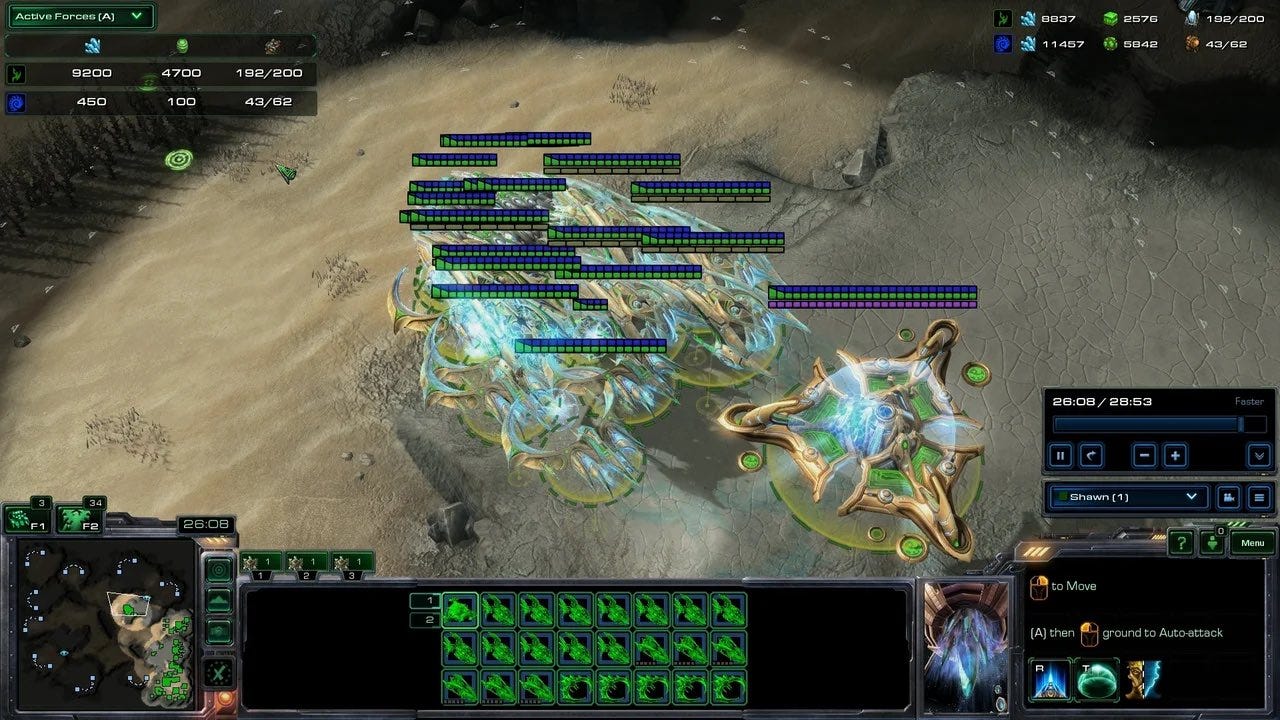
But if you spent 2001 through 2015 commanding Zerg swarms, building Factorio pipelines, or expanding Civilization empires, you internalized something profound:
Complex systems respond to whoever understands which units to deploy, when, and in what sequence.
Everything else is noise.
Here’s why this matters now.
McKinsey just published research showing 45% of companies with extensive AI adoption expect to reduce middle management layers. MIT Sloan says the next generation of leaders will be “orchestrators, not overseers.”
Fortune reports that CEOs need people who can:
“Combine business judgment, technical fluency, and ethical awareness to guide hybrid teams of humans and agents.“
Read that again. Hybrid teams of humans and agents.
That’s not a metaphor. That’s the job description for 2026 and beyond.
And where did people train for this job?
Not in classrooms. Not in internships. Not in leadership development programs.
In games where you commanded hybrid armies of different unit types, each with unique capabilities, coordinating them in real-time toward strategic objectives.
The $0 MBA
Let me frame this differently.
A traditional MBA:
Cost: ~$200,000
Duration: 2 years
Output: Frameworks, case studies, networking
Valuable, certainly.
But it doesn’t teach you to manage 200 units across three control groups while simultaneously:
Expanding your economy
Scouting enemy positions
Adapting your composition to counter an unexpected strategy shift
All in real-time
With no pause button
That skill — holding multiple systems in your head while making rapid decisions under uncertainty — is precisely what agentic AI work demands.
When I’m running Claude Code with sub-agents on a complex product build, my brain enters the same state it did during a late-game StarCraft match:
Multiple specialized units doing their jobs
Resources flowing
Fog of war slowly lifting as scouts report back
Constant micro-adjustments while protecting the macro
The tuition for this education was $0.
The credential is nonexistent.
The preparation is complete.
The Fog of War
In every RTS game, you start blind.
The map is black. You only see what your units reveal.
This creates the fundamental strategic tension: you must make decisions with incomplete information while actively working to gain more visibility.
You send scouts. You build Observers. You use Scanner Sweeps. Every bit of vision you gain informs better decisions.
This is exactly the situation AI agents face today.
Your agents don’t know everything. They can’t see your Google Drive, your Slack history, your database, your CRM. They’re operating in fog of war, making probabilistic decisions with partial context.
MCP (Model Context Protocol) is the equivalent of building Observers and Scanner Sweeps.
It lifts the fog.

What is MCP?
Before MCP, every AI-to-tool connection required custom engineering:
Want Claude to access Google Drive? → Build a connector
Query your database? → Another connector
Slack? GitHub? Salesforce? → Each one, a separate project
MCP changes this completely.
One universal protocol. Thousands of compatible servers.
As Anthropic describes it: “the USB-C of AI.”
As of December 2025:
✅ Adopted by OpenAI
✅ Adopted by Google DeepMind
✅ Adopted by Microsoft
✅ Now managed by the Linux Foundation’s Agentic AI Foundation
This isn’t a trend. It’s infrastructure. Like HTTP for the web.
MCP Servers = Tech Tree Unlocks
For RTS players, the analogy clicks instantly.
Each MCP server grants new capabilities:
🔗 Google Drive MCP —Vision into documents
💬 Slack MCP — Awareness of team communications
🐙 GitHub MCP — Access to code repositories
🗄️ Postgres MCP — Database reconnaissance
📝 Notion MCP — Knowledge base connection
🚨 Sentry MCP — Error patterns and production issues
📚 Context7 MCP — Real-time, up-to-date documentation
Instead of building each capability from scratch, you install MCP servers and your agents gain sight.
The more visibility, the better decisions.
This is scouting. This is map control. This is the foundation of every strategic victory you’ve ever achieved in an RTS.
Three Games, Three Cognitive Architectures
Here’s what’s genuinely overlooked.
Different game genres trained different skills. And those skills map to different aspects of agentic AI work with surprising precision.
🎮 StarCraft & Warcraft
Real-Time Multi-Agent Orchestration
What these games trained:
Control group management for instant unit access
Micro vs. macro balance — when to intervene vs. trust the system
APM discipline — execution speed under pressure
Opponent reading from incomplete signals
Army composition theory
Where it applies now:
Running sub-agents in Claude Code. Managing multiple specialized tools simultaneously. Knowing when to let the AI handle things and when to step in.
When I work with my sub-agent setup, the rhythm is identical to late-game StarCraft:
Check mvp-planner output      → Ctrl+1
Review code-builder produced  → Ctrl+2
See if debugger found issues  → Ctrl+3
Run test-runner recon         → Ctrl+4
Back to main objective
The hotkey instinct transfers directly.
DeepMind’s AlphaStar research documented this. The AI learned that StarCraft mastery requires both “micro” (precise unit control) and “macro” (broad strategic planning).
The same two-layer thinking applies to AI orchestration today.
🏭 Factorio
Pipeline Architecture & Systems That Build Systems
What Factorio trained:
Systems thinking — inputs → processing → outputs → feedback
Bottleneck identification — where does it break?
Automation design — systems that build systems
Scale management — what works at 10x breaks at 100x
Throughput optimization and ratio balancing
Where it applies now:
MCP pipeline design. Workflow automation. Building agent systems that scale. Understanding why your context window is getting polluted.
Factorio players learned to ask the questions that matter:
“What is the throughput of this system?”
“Where does it break?”
“How do I add capacity without redesigning everything?”
A recent academic paper used Petri Net theory to model Factorio pipelines, treating the game as a legitimate operations research problem.
The researchers found that Factorio teaches the same principles used in real-world manufacturing optimization.
When you’re configuring MCP servers and managing agent workflows at scale, these are the exact questions:
How many MCP servers before context consumption kills performance?
(Answer: 40%+ of your 200k context window can disappear at startup)
Where are the bottlenecks in my agent pipeline?
How do I add capabilities without rebuilding?
Factorio thinking is MCP thinking.
🏛️ Civilization
Tech Trees & Strategic Capability Building
What Civilization trained:
Tech tree navigation — sequencing capability unlocks
Resource allocation across timescales
Multiple victory conditions — which game are you actually playing?
Opportunity cost — every choice closes other doors
Long-term planning under uncertainty
Where it applies now:
Technology roadmapping for AI adoption. Deciding which capabilities to unlock first.
Civ players internalized something crucial:
You can’t research everything at once, so sequencing matters enormously.
You can’t rush the endgame without building the economic foundation. Prioritization isn’t optional — it’s the entire game.
This is exactly how AI capability building works:
❌ Can’t deploy multi-agent workflows before basic MCP connectivity
❌ Can’t orchestrate sub-agents before understanding single agents
❌ Can’t run Ralph Loop overnight before learning prompt convergence
The tech tree mentality is the correct mentality.
My Personal Loadout Screen
Here’s how gaming logic shapes my actual AI workflow.
I’m getting specific because specificity is what separates insight from platitude.

🔵 Claude Code — The Main Army
This is where production happens. Serious architecture, serious debugging, serious building.
Claude Code with sub-agents feels like commanding a Protoss death ball. Each unit specializes. They chain together. The whole exceeds the sum.
Key insight: Sub-agents can invoke each other.
Your debugger calls your test-runner. Your business planner summons your revenue modeler.
It’s like giving your army Slack — except they actually use it.
My Engineering Squad (Ctrl+1):
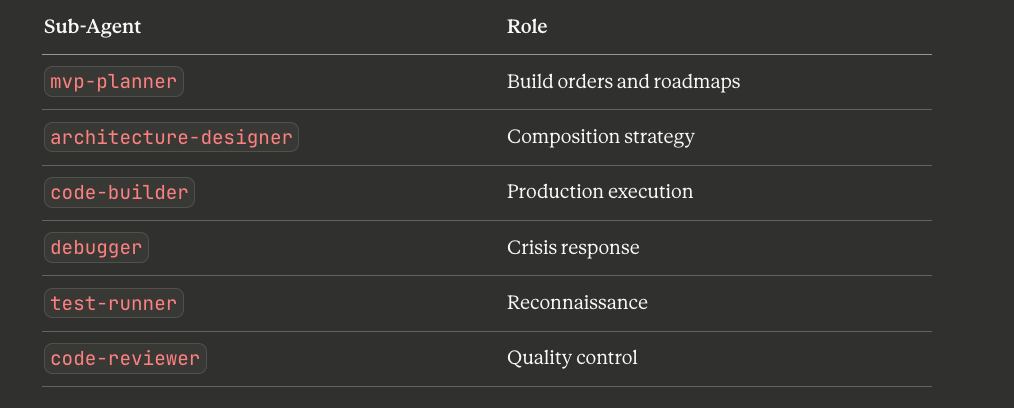
My Business Squad (Ctrl+2):

You don’t send Carriers to mine minerals.
You don’t ask your debugger to write marketing copy.
🔄 Ralph Loop — Autonomous Overnight Ops
Here’s a tool that perfectly embodies RTS thinking.
The Ralph Loop plugin for Claude Code (named after Ralph Wiggum from The Simpsons — tech has a sense of humor).
How it works:
You give Claude a task
Claude works on it
When Claude tries to exit, a Stop hook blocks the exit
The same prompt feeds back in
Files from previous iteration persist
Repeat until completion criteria met
The philosophy, from Geoffrey Huntley who popularized it:
“Better to fail predictably than succeed unpredictably.”
This is pure RTS thinking.
You don’t micro every Marine’s trigger finger. You give orders, set victory conditions, and let the system iterate. You provide guardrails and trust the loop.
Real results people are reporting:
💰 $50k contracts completed for $297 in API costs
📦 Six repos shipped overnight
🔧 Complete programming languages built through 3-month loops
To use it:
/ralph-loop "Build a REST API for todos. When complete:
- All CRUD endpoints working
- Input validation in place
- Tests passing (coverage > 80%)
- README with API docs
Output: <promise>COMPLETE</promise>" --max-iterations 50
The RTS insight: Iteration beats perfection.
You don’t need the first output to be perfect. You need a system that can iterate toward correctness.
📚 Context7 MCP — Real-Time Doc Scouting
Claude’s knowledge cutoff means it doesn’t know about:
React 19 changes
Next.js 15 updates
Any framework evolution from the past year
You end up debugging hallucinated APIs that existed in older versions.
Context7 provides real-time, version-specific documentation directly in prompts.
bash
claude mcp add context7 -- npx -y @upstash/context7-mcp@latestIt’s an Observer that scouts current documentation instead of relying on old intel.
🧠 Sequential Thinking MCP — Build Order Planning
Forces Claude to break complex problems into steps before attempting solutions.
Instead of jumping to code, it maps the approach first.
The RTS equivalent: Planning your build order before the game starts.
bash
claude mcp add @modelcontextprotocol/server-sequential-thinking🔍 Gemini — The Deep Scout
Google’s Gemini is my reconnaissance tool.
Massive context window. Deep Google ecosystem integration.
When I use it:
Processing 200-page documents
Exploring unfamiliar territory
Pulling from Google-native sources
It’s the Observer. Not the main fighting force, but essential for lifting fog of war in specific domains.
⚡ OpenAI — Quick Reaction Force
ChatGPT is my fast-reaction tool.
Quick ideation. Rapid prototyping. General-purpose tasks without deep integration.
Marines. Versatile, fast to produce, good in many situations — but not for complex multi-step operations.
The Composition Principle
PhaseToolWhy💡 IdeationOpenAISpeed and breadth🔬 ResearchGeminiDepth and context⚙️ ExecutionClaude CodePrecision and orchestration🌙 OvernightRalph LoopUnattended iteration
You don’t mass one unit type and hope for the best.
You build what the situation demands.
The moment you treat AI tools as interchangeable commodities, you’ve already lost the strategic game.
The Macro vs. Micro Trap
Every RTS player knows this failure mode.
You get so focused on micro-managing one battle that you forget to build workers back home. Your opponent expands while you’re dancing Mutalisks around turrets.
You win the fight but lose the war.
The same failure mode kills AI projects constantly.
People obsess over perfecting one prompt, one interaction, one output.
Meanwhile, they’ve forgotten to:
⬜ Set up pipeline architecture
⬜ Build MCP connections
⬜ Design context management strategy
⬜ Plan for scale
⬜ Create sub-agents for recurring tasks
⬜ Establish feedback loops for improvement
Good RTS players glance at their base every few seconds, no matter how intense the battle.
The pros call this “macro check” — it happens subconsciously.
Good AI operators learn the equivalent:
Is my overall system healthy?
Are my MCP connections stable?
Is my context management scaling?
Am I building capacity while fighting current fires?
Have I documented what works?
The question isn’t “Is this output perfect?”
The question is “Is my overall system getting stronger?”
Macro wins games. Micro wins battles.
Don’t confuse the two.
Context Management = Supply Limits
Here’s a specific RTS lesson that transfers directly.
In StarCraft, you have a supply limit.
You can’t build infinite units. Every unit costs supply. You need supply depots (or pylons, or overlords) to increase your cap.
In AI work, you have a context window limit.
Every MCP server you add, every tool definition, every conversation chunk consumes context.
I’ve seen people add 15 MCP servers and wonder why their agent is slow, expensive, and confused.
They hit supply cap without building more pylons.
One developer’s experience:
“Less is more, especially for context management. Too many MCPs consume context — sometimes over 40% of the 200k context window just for MCP tools at startup.”
This is supply management:
✅ You don’t need every MCP server
✅ You need the right MCP servers for the mission
✅ Add Context7 because you need current docs
✅ Add GitHub MCP because you’re working on code
❌ Don’t add Zapier unless you actually need cross-app automation
Trim unused capabilities.
Monitor context consumption.
Build more “pylons” by organizing tools efficiently — not just adding more.
What’s Actually Being Selected For
Here’s the uncomfortable truth.
The hiring market is quietly selecting for skills that have no formal credentials.
When MIT says companies need people who can “supervise, critique, and orchestrate” AI agents — they’re describinga capability that didn’t exist in any curriculum until 2024.
When McKinsey says organizations need an “agentic factory” with people who understand “multiagent orchestration patterns,” they’re describing knowledge that lived exclusively in gaming communities and research labs.
When Fortune says leaders must guide “hybrid teams of humans and agents,” they’re describing exactly what happens when you command a mixed army toward a strategic objective.
The people who spent 25 years being told they were wasting time?
They were building the cognitive architecture that’s now in the highest demand.
The game wasn’t a distraction from valuable work.
The game was the work.
The Practical Playbook
If you’re building with AI agents today, here’s the gaming wisdom that transfers:
1️⃣ Create control groups, not monoliths
Stop making one AI do everything.
Build specialized sub-agents. Assign invocations. Call the right group for the right task.
Ctrl+1 for engineering
Ctrl+2 for business
Ctrl+3 for research
2️⃣ Protect your macro
Don’t get lost perfecting individual outputs.
Monitor overall system health. Macro check every few minutes, even during intense work.
3️⃣ Scout relentlessly
Use MCP to lift fog of war.
Start here:
GitHub MCP
Google Drive MCP
Two connections that dramatically expand agent visibility.
4️⃣ Know when to micro
Some tasks need direct intervention. Others can be delegated.
The skill is knowing which is which.
Micro the high-stakes moments. Trust automation (Ralph Loop) for iteration-heavy work.
5️⃣ Build your tech tree
Each MCP server unlocks new capabilities. Each sub-agent expands composition options. Each plugin adds commands.
Think progression, not one-time setup.
Remember: You can’t skip prerequisites. Foundation before advancement.
6️⃣ Manage your supply
Monitor context consumption. Trim unused MCPs. Every tool definition costs tokens.
The constraint is real. Manage it like a supply in a long game.
7️⃣ Iterate, don’t perfect
The Ralph Loop philosophy:
“Better to fail predictably than succeed unpredictably.”
Write prompts that converge. Set clear completion criteria. Let the system iterate.
More effective than perfecting first try.
The Generation That Trained
There’s a reason so many AI builders have gaming backgrounds.
We practiced this.
Not consciously. Not strategically.
We just loved commanding armies, building factories, managing empires, and outmaneuvering opponents in real-time.
Now that same mental architecture applies to the most valuable professional skill of 2026:
Orchestrating AI systems to accomplish complex goals.
The idea guys are having their day, as I wrote a few months ago.
And the idea guys who also played RTS games?
We’ve been running unpaid training simulations for 25 years.
The tuition was $0.
The credential is nonexistent.
The preparation is complete.
What games shaped how you think? Which mental models stuck?
Post-Credit Scene
I was not on drugs when I wrote this. I am passionate about the RTS genre of games where you need to think, build, control, and win. So based on what you just read, here you go:
StarCraft 2: For nostalgia and for training. The mental models transfer directly.
To read you can: “The Art of Game Design” by Jesse Schell — Why game mechanics create powerful learning environments.
🛠️ Install: Ralph Loop plugin for Claude Code. Start small, verifiable tasks. Set --max-iterations 20. Learn autonomous iteration rhythm.
🔌 Connect: Context7 MCP for current docs:
claude mcp add context7 -- npx -y @upstash/context7-mcp@latestThanks for reading.
Vlad