

Hey. It's a busy week indeed, so…
You know the shot. Green characters raining down on a black screen. Cypher says he doesn’t even see the code anymore. I had my version of that moment this morning: three tickers open, and the realization was simpler than his:
The code rain was always prices. This week the simulation stopped hiding them.
A good Matrix day. Three frontiers, 96 hours, one pattern.
Every unpriced frontier eventually gets a meter.
The receipts first. Then the framework. Then the part nobody is connecting.
The receipts, June 9 to 12, 2026
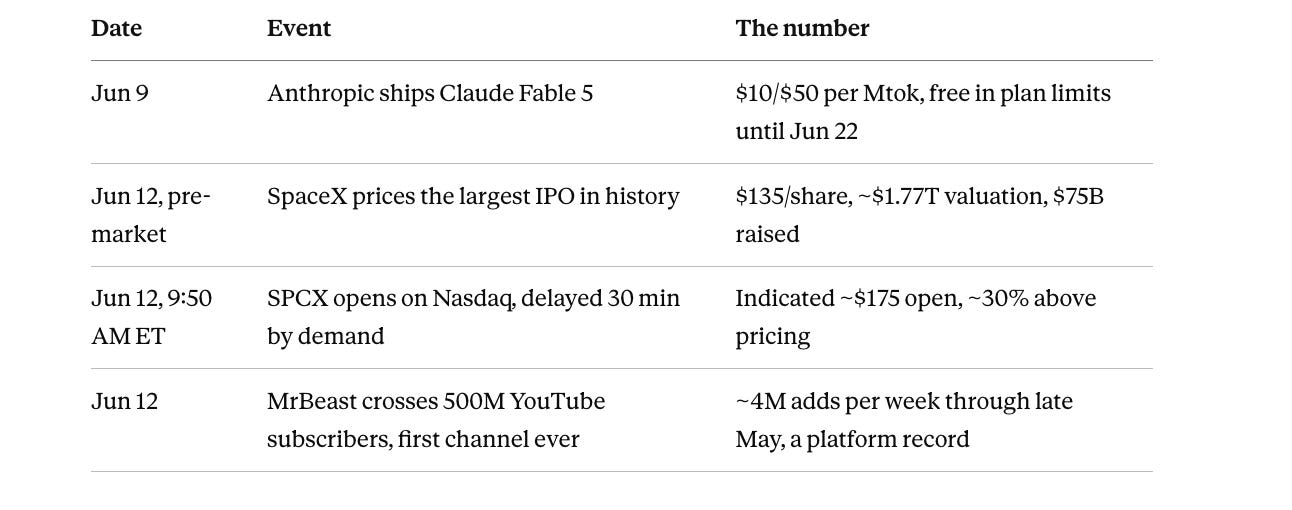
Intelligence got a meter. Capital got a ticker. Attention got a census. Same event, three costumes.
Midjourney: “green Matrix code rain resolving into stock tickers and price tags, dark trading floor”

Is that a Fable?
Claude Fable 5 is the gated Mythos 5 made buyable: same model, classifiers in front of cyber, bio, and distillation, fallback to Opus 4.8 when one trips. Fewer than 5% of sessions ever see a classifier. SWE-Bench Pro 80.3% against Opus 4.8’s 69.2%. Apply the standing 10 to 15 point discount on launch numbers (Ch 25: evals or hope) and the shape survives.
On May 6 my research notes recorded Anthropic disclosing Mythos and refusing to ship it. I read that as a capability ceiling they would not productize. Wrong call, interesting mechanism. They didn’t choose between shipping and withholding. They split the model. The correction note went up the day Fable landed, and the full operator file- every benchmark, every caveat, the system-card episodes- lives at the Fable 5 model file.
The operator clock: June 22 is the day the intelligence meter starts. Until then the most capable model ever sold sits inside the plan you already pay for. Ten days. The cheapest private-eval window you will get this year.

How big is the SpaceX IPO?
The biggest ever, and it is not close. SpaceX (Nasdaq: SPCX) priced at $135 per share Thursday evening, around a $1.77 trillion valuation, past Saudi Aramco’s 2019 record. The $75 billion raise is a figure typically associated with entire IPO years. Demand ran multiples past supply. Most retail orders got a fraction or nothing, and those buyers now face a stock indicated to open near $175.
Two details matter more than the pop.
First, this is not a rocket company. After the xAI merger, one ticker now prices in launch, Starlink, Starship, and a frontier AI lab. The market just priced matter and mind in a single line item.
Second, every pre-IPO holder bought when there was no ticker at all. Today’s price discovery is the reveal, not the opportunity. The opportunity was the quiet 24 years. Hold that thought.
I’m not telling you whether to buy SPCX. I’ll tell you what I’m watching before I touch it: lockup expiry dates, the first public earnings print, index inclusion flows. Data arrives after adrenaline leaves. Decide on the data.
500 million subscribers
By compounding through the longest free window in media history. The timeline is the argument:
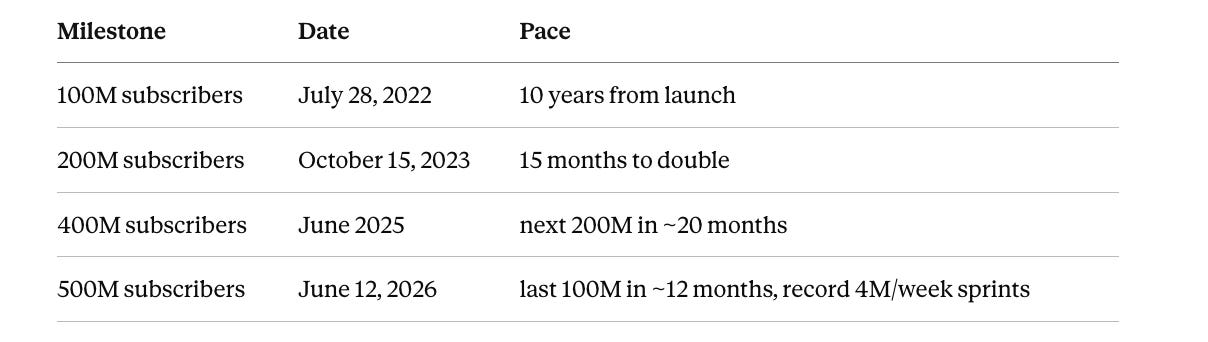
Five hundred million is more people than live in the European Union. First half-billion channel in YouTube history, and the gap to number two has never been wider. He built it on a platform that, for most of those years, paid you in reach for being good. Distribution was the subsidy.
Anthropic’s 81,000-interview study found independent workers report economic empowerment from AI at 50% versus 14% for institutional employees, a 3.5x gap. That is the distribution MrBeast sits on the far right tail of. The leverage of open platforms flows to operators, not to institutions. It always has.
And the detail almost everyone skipped this week: Beast Industries has reportedly been pitching brands on building the world's largest membership service. Read it through today’s lens. The man who extracted more value from free distribution than anyone alive is installing a meter on his own audience.
The fortune is positioned during the free window and revealed at the meter. He knows the order of operations. He lived it.
The Law of the Meter
One table, three stories, no coincidence:
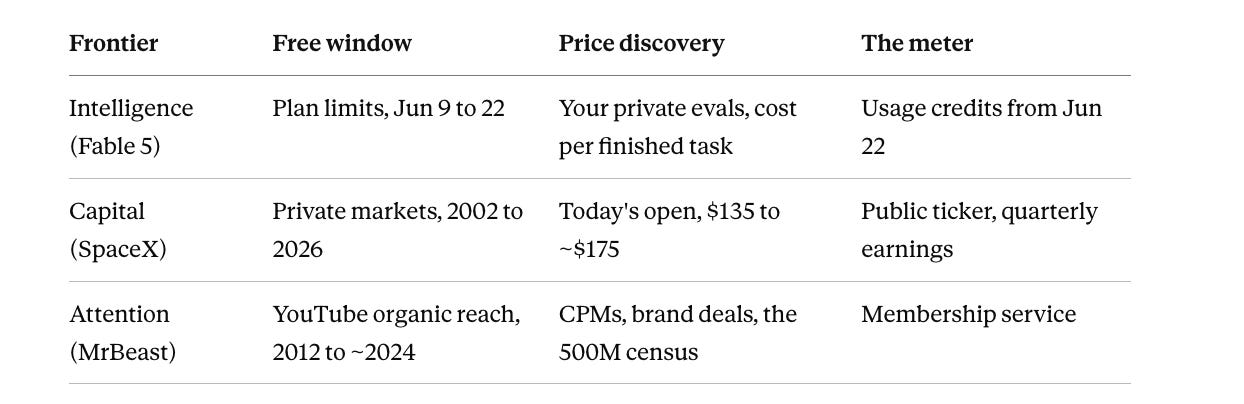
And here is why I’m confident the AI meter is structural, not a launch-week promo. Two days before Fable landed, I filed a research note on the X analysis with subscription grid. A $200 flat-rate plan can draw roughly $8,000 of API-equivalent compute at full utilization.
The plans break even only when average users consume 10 to 20% of their cap. Altman said it in plain text back in January 2025: “we are currently losing money on OpenAI Pro subscriptions.” Every limit you have ever hit- the 5-hour window, the weekly cap, the June 22 transition- is the same mechanism dragging utilization back into the green columns. The meter is not a metaphor. It is arithmetic.
So the Law: a frontier opens unpriced or subsidized. Builders who arrive early accumulate at a discount nobody else can see. Price discovery arrives, the meter gets installed, the discount is gone forever. SpaceX employees were not smarter than today’s retail buyers. MrBeast was not luckier than a creator starting in 2026. They were early to a free window and worked it while it was open.
Which leaves the only question that pays:
Where is the free window open right now?
Here is what almost nobody is connecting. The fastest-growing distribution channel of 2026 is AI assistants answering questions, and right now they cite their sources for free. No auction. No placement fee. If your page is the clearest, best-structured answer to a question, the engines lift it into the response and send the curious your way.
AI citation is the cheapest distribution on the internet right now, and almost nobody is structuring for it.
We have seen this movie. Google results had no auction until AdWords. Facebook organic reach was a firehose until it collapsed to single digits. Every distribution channel in history eventually got a meter. Answer engines will not be different. The years before that meter arrives are the YouTube circa 2014 of this cycle.
I wrote earlier this month that AI killed cheap distribution and that trust plus human curation is the new moat. This is the constructive half of that argument. Engines cite what they can trust, parse, and verify: receipts, dates, named things, direct answers. The qualities that make a page citable are the qualities that make it trustworthy. The window rewards the work worth doing anyway.
Full disclosure: I am running this experiment in public. Vlad’s Playbook shipped its reference layer this week, five search-facing pages built on receipts the official docs can’t print, and every deploy now pings the indexes ChatGPT and Claude actually read from. This edition is built the same way: question-shaped headings, answer-first paragraphs, dated facts, a FAQ. Watch what I do, not only what I say.
What I would do with the next ten days
Run the Fable 5 eval while the meter is off. Three workloads where Opus 4.8 makes you wait or retry. Keep every transcript. The method is Ch 25, the cost maths is Ch 29, the routing stays on the live tier list.
Treat SPCX as a data problem, not an adrenaline problem. Lockups, first earnings, index flows. The pre-IPO discount is gone. What remains is a normal stock requiring normal homework.
Build one citation asset this month. Take the question your customers ask most and publish the definitive answer page: question headings, direct answers, real numbers, a FAQ. The Fable 5 model file is my template; steal the shape. If you are starting from zero, day zero is the on-ramp and the 30-day plan is the cadence.
Name your own free window. Somewhere in your industry a frontier is still unpriced. The Law says it will not stay that way. Position now, get revealed later.
Back to the code rain.
The red pill was never about escaping the system. It was about seeing it render. This week the system rendered three of its biggest variables in plain text: what intelligence costs, what the future of transport and compute is worth, how many humans one person can reach. Frontiers do not usually announce when their free windows close. This week three of them published the dates.
Use the dates. Keep the transcripts. Build the page.
Thanks for being here on a Friday, and thanks to everyone who replied to Tuesday’s edition with their own Fable evals. Those replies are becoming next week’s data, which is exactly how this is supposed to work.
Post-Credit Scene
Got to another post-credit scene, bless you. Here is quick FAQ for new people here
What is Claude Fable 5 and how much does it cost?
Claude Fable 5 is Anthropic’s most capable generally available AI model, released June 9, 2026. It is the gated Mythos 5 model with safety classifiers added, priced at $10 per million input tokens and $50 per million output tokens, double Claude Opus 4.8. It is included in paid Claude plan limits until June 22, 2026, then requires usage credits.
What is the SpaceX IPO price and valuation?
SpaceX priced its IPO at $135 per share, valuing the company at roughly $1.77 trillion, the largest IPO in history. Shares began trading on the Nasdaq under the ticker SPCX on June 12, 2026, with early indications around $175 and the company raising about $75 billion.
Is MrBeast the first YouTube channel with 500 million subscribers?
Yes. MrBeast (Jimmy Donaldson) became the first channel in YouTube history to pass 500 million subscribers on June 12, 2026, after hitting 100 million in July 2022, 200 million in October 2023, and 400 million in June 2025.
What do Fable 5, the SpaceX IPO, and MrBeast’s milestone have in common?
All three are frontiers getting priced in the same week: intelligence (usage credits from June 22), capital (a public ticker after 24 private years), and attention (a half-billion census followed by a planned membership service). The pattern: every unpriced frontier eventually gets a meter, and the advantage belongs to whoever positioned during the free window.
Is Anthropic also going public?
Anthropic has not announced an IPO, but reporting around the Fable 5 launch noted the company is widely expected to pursue one, possibly as soon as this year.
And like always something useful for you with love from me.
Liftoff by Eric Berger. SpaceX in the years when there was no ticker, no price, and barely a payroll. The free window, documented.
Matt Levine’s Money Stuff on IPO pops. The cleanest explanation of why a 30% first-day jump is called money left on the table, and who left it.
Colin and Samir’s long MrBeast interview. The craft under the spectacle: retention curves treated the way engineers treat latency.
The Architect scene, Matrix Reloaded. Rewatch it as a systems-pricing monologue instead of philosophy. Best ten minutes ever filmed about equilibria.
The research notes. My running log of what the labs ship and what it changes for operators. The subscription-subsidy grid and the Mythos correction both live there, with the receipts.
Thanks for reading
Vlad