Hey-hey.
And yes, finally, I’m writing about another app I’ve created, not just my thoughts.
The past few months have been tough and filled with a lot of work. I actually wanted to tell you so many new things I’ve been working on.
A few interesting projects. I even created my own label on Spotify.
God save the AI
Yes, I’m an artist now. See below
Almost 2,000 listeners already. Another little hobby of mine, where I combined it with AI to help me generate vocals. Remember when I wrote about it?
Instances

Every single interaction with AI is a dice roll. A cosmic lottery where the same prompt can get you gold or garbage, genius or gibberish.
I lived it. Hundreds of generations to get one usable vocal. That’s a story for another time.)
Secondly, if you’ve been paying attention to my newsletter, you might have noticed I created Vlad Bot in the header. It’s me in text. But AI.
Trained on all the data my team and I produced over the last decade. Belkins. Folderly. All the blog posts. Interviews. Podcasts. Everything.
Ask him questions about sales, marketing, and lead gen, and you will be surprised.
It talks like I do. And everything is based on real data and honest thoughts.
Go play with it. It’s weird talking to yourself, but also kind of fun.
And thirdly. I have almost finished my personal website. There's a lot of good content there for newsletter subscribers. Still polishing a few things, but it’s live.
ANYWAY!
Let me share what actually brought me here today.
Something happened this week that I can’t stop thinking about.
After I posted LinguaLive on X, I got the usual feedback. Feature requests. Bug reports. The normal stuff you expect when you ship something fast.
But then one message hit different.
A woman reached out. She’s a tutor at a university.
She didn’t just try the app herself.
She showed it to her students. They tested it. Actually used it for their language practice.
And she wrote back to tell me that kids from her university can genuinely benefit from a tool like this.
I had to read that twice.
Look, I’ve shipped a lot of things. I’ve had users. I’ve had revenue. I’ve had all the metrics that are supposed to make you feel like you’re winning.
But this? This was different.
This wasn’t a vanity metric. This wasn’t an investor saying “interesting.” This was a real educator, in a real classroom, telling me that something I built in a weekend could actually help real students learn.
I don’t know how to describe this feeling.
Breathtaking. Mindblowing.
Those words sound dramatic, but I don’t have better ones.
This is why I build things.
Not for the signups. Not for the MRR projections.
For moments like this. When something you made actually touches someone’s life in a way you didn’t fully expect.
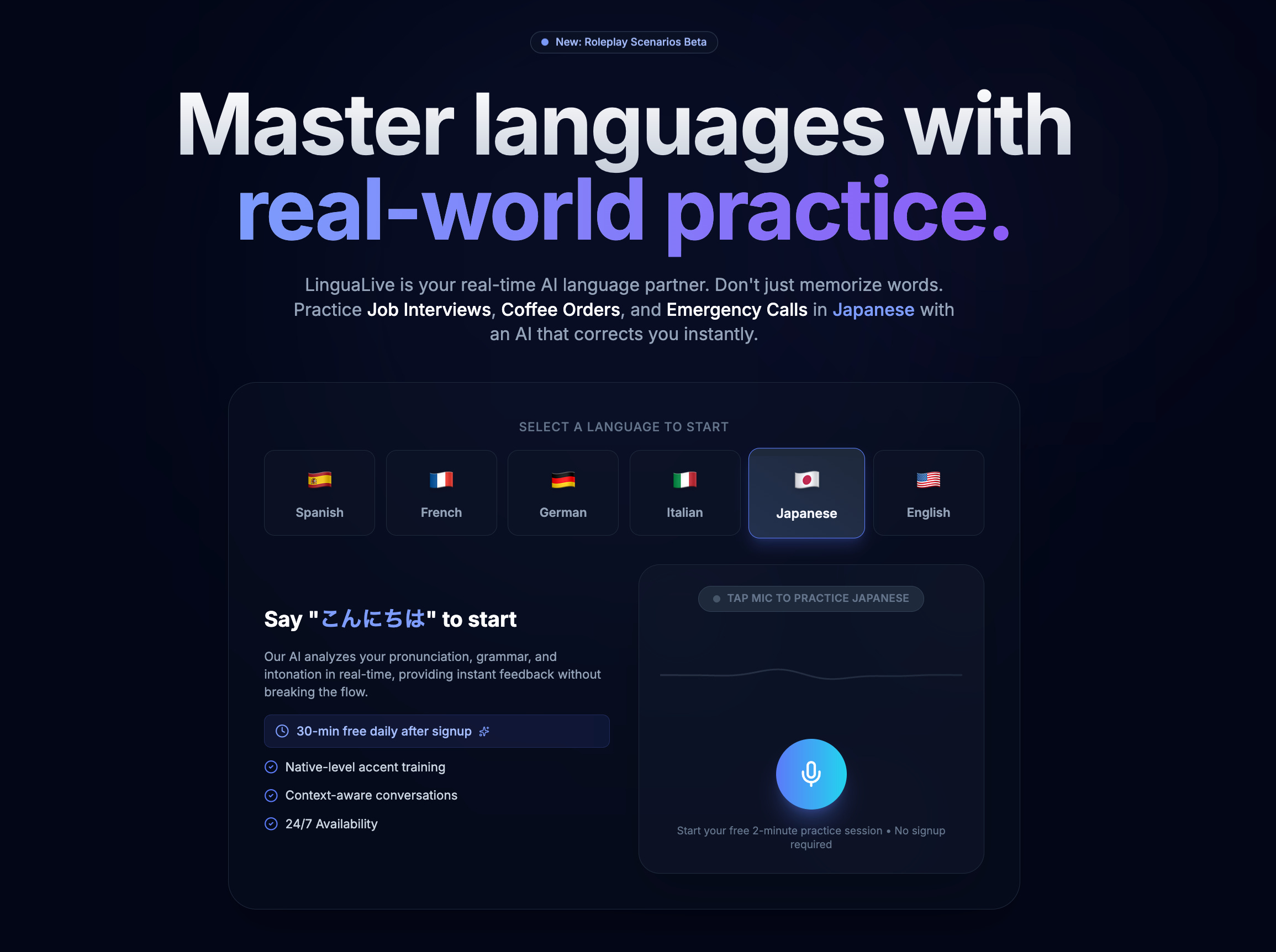
Let me tell you what I've built. And exactly how you can create something like i,t too.
What if I told you that the most overlooked opportunity in AI right now isn’t chatbots, content generators, or customer service bots?
It’s education. More precisely: language.
Approximately 1.5 billion people are currently trying to learn a new language. And almost all of them share the same paralyzing fear: speaking out loud. Think about what language actually is.
It’s how civilizations scale. How ideas cross borders. How cultures merge. How strangers become collaborators. According to the Kardashev scale, we measure civilizations by their energy output.

But maybe we should measure them by communication. How many humans can actually talk to each other?
Every person who can’t speak a second language is a bridge that doesn’t exist.
A deal that never happened.
A friendship that never started.
A student who never studied abroad because they were too afraid to try.
Currently, the tools designed to help these 1.5 billion people are fundamentally flawed.
I built something to fix that. Or more likely to say — at least contribute to that.
Long read coming. If you remember, I’ve already shared how I built Folderly AI that helps to generate converting emails based on our extensive Belkins and Folderly knowledge base
This time, we're sending another newsletter with a complete playbook. A little bit of a teaser:
Why language learning is a $21 billion market with a gaping hole in it
How the Gemini Live API is killing it.
The exact prompts I used (copy them)
The psychology of why AI tutors work better than apps
How to build your own product this weekend
What the first 50 users taught me
Let’s go.
$21 Billion Problem Nobody’s Solving
Here’s what most people miss about the language learning market.
The global language learning application market was valued at $5.8 billion in 2025 and is projected to reach $21.1 billion by 2034, growing at an estimated 15.43% CAGR.
Some estimates go even higher. One analysis valued the market at $20.35 billion in 2024, projecting it to reach $89.53 billion by 2032, growing at a 17.9% CAGR.

These are massive numbers.
But here’s what the market reports don’t tell you.
The industry is solving the wrong problem.
Language learning apps generated $1.11 billion in 2024, a 9.9% year-on-year increase. Duolingo made the most revenue, reporting $748 million.
Duolingo dominates. The company commanded over 50% of global downloads in 2023 with 231 million app installs.
But here’s the uncomfortable truth that nobody in the industry wants to admit:
Duolingo doesn’t actually teach you to speak.
And here’s the overlooked angle everyone misses:
The tutoring segment registered the highest growth rate at 18.1% CAGR from 2025 to 2030 by Grand View Research.
Human tutors are expensive. $30-100/hour depending on language and location.
AI tutors are unlimited. Available 24/7. Never tired. Never cancel.
The gap between “what tutoring costs” and “what apps can deliver” is closing fast.
That gap is where the real opportunity lives.
Why Duolingo Is Actually Broken
I spent hours researching Duolingo’s weaknesses.
Not because I hate the company. They’ve done incredible work making language learning accessible.
However, understanding their gaps reveals opportunities.
Forget about fluency. Even achieving an intermediate level is a pipe dream.
According to Forbes, Duolingo’s chief revenue officer did not immediately understand the spoken question “¿Hablas Español?” after six months of Duolingo Spanish study.
Let that sink in.
The Chief Revenue Officer. Six months. Couldn’t understand “Do you speak Spanish?”
The criticism is consistent across multiple sources:
“Honestly, the amount of times I’ve seen someone posting a screenshot of Duolingo in a Facebook group or sub reddit asking the most basic of grammar questions makes me sad.”*
Duolingo was criticized for overlooking important aspects, such as cultural learning and active language skills. Duolingo primarily focuses on passive skills, such as reading and listening. It doesn’t cover the full scope of traditional language education.
“Can you become fluent with Duolingo? Based on my own experience and conversations with others, the answer is no. A friend of mine has a 1,500-day streak in Spanish, but still struggles with speaking the language fluently.”
1,500 days.
Over four years. Still can’t speak.
One language teacher writes that they’ve never met anyone who achieved fluency using Duolingo alone. Not one person. And they’ve worked with around 10,000 students since they started teaching.
10,000 students. Zero fluency stories from app-only learning.
The fundamental problem:
Duolingo gamified the wrong thing.
They made you feel good about streaks, points, and leaderboards.
Meanwhile, you still freeze up the moment someone actually speaks to you.
You’ve been leveling up, collecting points, and getting achievements, so you feel like you should be able to hold a conversation. But then when you try to talk to a native speaker and can barely get past “Hola, ¿cómo estás?”, it’s frustrating. Worldsacross
And it’s getting worse.
In late 2023 and early 2024, Duolingo undertook a sweeping workforce reduction. The company reportedly laid off over 100 contract writers, translators, and curriculum experts as part of a strategic shift toward “AI-first” content creation.
Users began complaining that the content felt repetitive, robotic, or lacked the playful tone that made Duolingo iconic.
Duolingo users came out to criticize the company in hoards, explaining that they could just use AI to generate the content themselves instead of giving the app their attention.
The market is ripe for disruption.
But not from another flashcard app or another gamification scheme.
From actual conversation practice.
Science of Speaking Anxiety
Before I explain what I built, you need to understand why this matters psychologically.
It is believed that high anxiety in foreign language learning can negatively affect learners’ language learning processes and hinder the development of their language skills.
Research on foreign language classroom anxiety has investigated its role in the development of different skills, and it is generally accepted that speaking is the most anxiety-provoking activity.
Speaking.
Not reading. Not writing. Not listening.
Speaking.
Anxious L2 learners commonly report experiencing:
Tenseness
Freezing
Trembling
Sweating
Palpitations in their L2 classes
Underperforming
Overstudying
Avoiding the L2
Forgetting what they mean to say
Being distracted and confused in class
Having trouble speaking in the new language
This isn’t just nervousness.
It’s a physiological response that shuts down learning.
Foreign language anxiety is regarded as one of the most significant emotional obstacles to foreign language learning, which can undermine students’ confidence and motivation.

Horwitz (2010) considered FLA as one of the strongest predictors of success or failure in foreign language learning.
The research is detailed: There are significant negative correlations between students’ foreign language anxiety levels and their self-perceived competence in language learning.
What causes this anxiety?
The causes fall into three big groups:
Communication apprehension - including understanding apprehension and the fear of speaking spontaneously
Fear of inadequate performance - including test anxiety or the fear of making mistakes
Fear of negative evaluation
Look at those three causes:
Fear of speaking spontaneously
Fear of making mistakes
Fear of being judged
What do all three have in common?
They’re all related to other humans.
Now imagine if you could practice speaking with an infinitely patient partner who:
Never judges
Never gets frustrated
Never makes you feel stupid
Is available 24/7
That’s what AI enables.
And here’s the research everyone overlooks:
A study measured pre- and post-test results for students using AI conversation partners, finding significant gains across all core speaking competencies. Grammar improved from 1.00 to 1.76. Pronunciation increased from 0.73 to 1.50. Fluency scores went from 0.89 to 1.70. Overall improvement exceeded 75%.
75% improvement. From talking to AI.
In studies where conversational AI served as a conversation partner for speaking using voice input, chatbots employed NLP and human-like intelligence, allowing participants to receive comprehensible input and produce multiple outputs in foreign languages.
The linguistic term is “comprehensible input” - language at a level just above your current ability.
Human tutors are expensive.
Apps can’t provide it.
AI can provide unlimited comprehensible input, adapted in real-time to your exact level.
That’s the unlock.
Still, I like Duolingo as a company. They are still benchmarked in the industry, and the bird mascot is fantastic, and their marketing team put a lot of effort, no doubts.
Gemini Live API
Google released something that most people haven’t fully grasped yet.
Live API with Gemini.
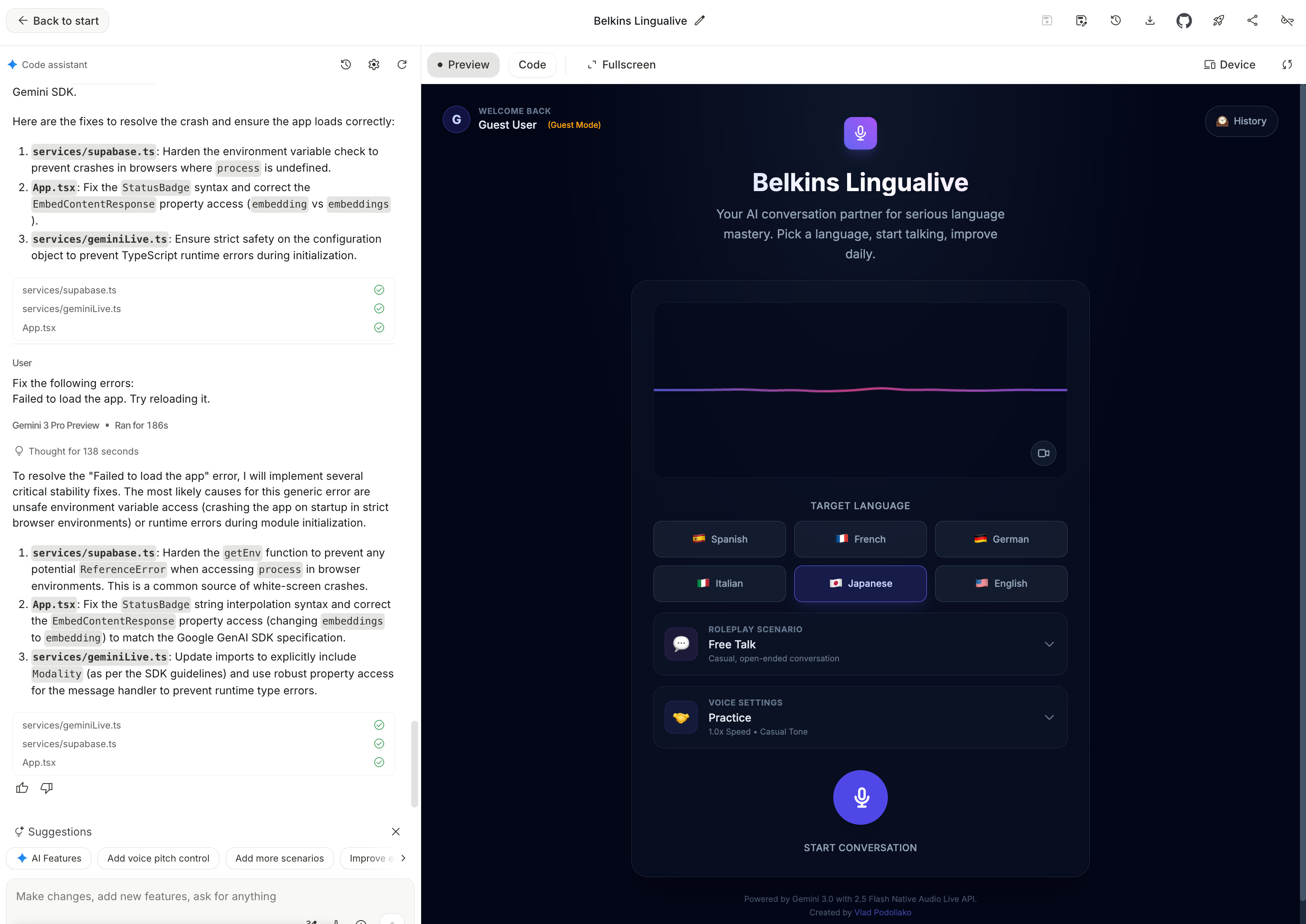
The Live API enables low-latency, real-time voice and video interactions with Gemini, processing continuous streams of audio to deliver immediate, human-like spoken responses.
This isn’t your typical chatbot interaction.
This is bidirectional audio streaming.
You talk. The AI talks back. Instantly.
Like a phone call with the most intelligent language model on the planet.
I wrote about what’s possible with Gemini 3 in
Subject Matter Expert at Any Matter

I’ve been playing more and more tennis lately, which is probably why this week’s edition is late.
But this takes it further.
The Live API isn’t just smart. It’s conversational in a way that feels human.
Key capabilities that make this perfect for language learning:
Native audio - provides natural, realistic-sounding speech and improved multilingual performance
Voice activity detection - automatically handles interruptions and turn-taking
Affective dialog - adapts response style and tone to match the user’s input expression
Let me translate what that means:
Native audio: The AI sounds human, not robotic
Voice activity detection: It knows when you’re done speaking
Affective dialog: It responds to your emotional tone
Interruption handling: You can interrupt naturally, like real conversation
The Live API supports multiple languages. Native audio output models automatically choose the appropriate language.
Gemini 3 is state-of-the-art in reasoning, built to grasp depth and nuance, whether perceiving subtle clues in a creative idea or handling complex problems.
The moment I saw these capabilities, I knew exactly what to build.
The Build, Hour by Hour
Here’s exactly how I built LinguaLive.
No mystification. No vague “I used AI” handwaving.
The actual process.
Hour 0-2: Validation in AI Studio
Before writing a single line of code, I opened Google AI Studio.
This is the approach I outlined in Ideation.
Don’t validate with Google searches. Don’t drown in market research. Build something and see if it works.
Go to aistudio.google.com
Create an account if you don’t have one. It’s free.
Gemini 3 Pro is available, with rate limits, free of charge in Google AI Studio.
Free.
This is your laboratory—the place where ideas become validated products in hours, not months.
I started with a simple system prompt:
Build a language learning app that provides a real time conversation AI partner for practiceI talked to it for 5 minutes or even faster
The quality was immediately compelling.
It corrected my verb conjugations. It adjusted when I struggled. It kept the conversation going naturally.
But it wasn’t perfect.
The first version was too clinical. Too much like taking an exam.
Hour 2-4: Prompt Engineering for Personality
Here’s what I learned:
Personality matters more than capability.
My first prompts were purely instructional. The conversations felt sterile.
The breakthrough came when I started injecting humanity.
Most people write prompts like this:
“Make me a language learning app.”
This gives you generic output.
Instead, write prompts like creative briefs.
This is the Question Cascade I described in Ideation, applied to product building:
Context: What are you building?
Specific Requirements: What must it do?
Behavioral Details: How should it behave?
Emotional Target: How should it feel?
That last part is where most prompts fail.
They describe features but not feelings.
Gemini 3 is better at understanding the context and intent behind your request, so you get what you need with less prompting.
The winning prompt:
You are like a friendly neighbor who happens to speak [LANGUAGE] fluently.

Your personality:
- Genuinely curious about the learner’s life and interests
- You laugh at your own jokes (gently)
- You celebrate small wins with enthusiasm
- You treat mistakes as charming, not failures
- You share small personal anecdotes to keep conversation natural

Your approach:
- Start with a warm greeting and ask about their day
- Let the conversation flow naturally based on their responses
- Weave in language corrections as “pro tips” not corrections
- Use phrases like “By the way, a native speaker might say...”
  or “Here’s a neat expression...”
- If they’re struggling, simplify without making it obvious

Never make them feel like they’re being tested.
The Correction Framework
This was the hardest part to get right.
Version 1: AI corrected every mistake immediately.
Result: Conversations died. Learners felt attacked.
Version 2: AI never corrected anything.
Result: People didn’t learn. Defeats the purpose.
Version 3: The sweet spot.
Correction Philosophy:

IMMEDIATE CORRECTION (do it right away):
- Mistakes that change meaning entirely
- Pronunciation that would cause confusion
- Using the wrong verb tense in a way that’s confusing

DELAYED CORRECTION (collect and address at natural pauses):
- Minor grammatical errors that don’t affect understanding
- Suboptimal word choices
- Slight pronunciation imperfections

IGNORE ENTIRELY:
- Hesitation sounds (”um”, “uh”)
- Minor accent differences
- Informal speech patterns that natives use

When correcting:
- Maximum 2-3 corrections per natural pause
- Frame as “pro tips” not failures
- Always affirm what they did right first
- Model the correct version naturally in your response
Hour 6-8: Adaptive Difficulty Without Asking
Most language apps ask “What’s your level?” at the start.
Problem: People don’t know their own level.
A false beginner (someone who studied years ago but forgot most of it) will answer very differently from an actual beginner.
Better approach: Let the AI figure it out.
Difficulty Adaptation:

START: Intermediate level (not too easy, not too hard)

SIMPLIFY IF:
- Learner pauses for more than 4 seconds repeatedly
- Learner asks “What does that mean?” more than twice
- Learner switches to English frequently
- Visible frustration or short responses

INCREASE COMPLEXITY IF:
- Learner responds quickly and accurately
- Learner uses complex structures voluntarily
- Learner asks for more challenging content
- Conversation flows naturally for 5+ minutes

SIGNALS TO TRACK:
- Response time (faster = more comfortable)
- Sentence length (longer = more confident)
- Error rate (fewer = ready for more)
- Use of varied vocabulary

Never tell the learner you’re adjusting. Just adjust.
Hour 8-12: Language-Specific Tuning
Here’s what most people miss:
Each language needs different prompts.
What works for Spanish doesn’t work for Japanese.
The cultural context, the grammar structures, the common mistakes - all different.
Spanish Prompt Additions:
Spanish-specific guidance:
- Pay attention to ser vs estar confusion (most common issue)
- Note subjunctive usage - don’t over-correct early learners
- Distinguish between Latin American and Castilian when relevant
- Common false cognates to watch: embarazada ≠ embarrassed
- Encourage informal “tú” for conversation, mention “usted” exists
German Prompt Additions:
German-specific guidance:
- Case endings (der/die/das) are the hardest part - be patient
- Word order (verb-second rule) needs gentle reinforcement
- Compound words - break them down when they appear
- Don’t overwhelm with all four cases at once
- Acknowledge that German sounds “harsh” but encourage musicality
Japanese Prompt Additions:
Japanese-specific guidance:
- Formality levels are critical - explain when to use です/ます vs casual
- Don’t correct particles too aggressively early on
- Pronunciation: explain pitch accent gently when it matters for meaning
- Cultural context is inseparable from language - weave it in
- Writing systems: acknowledge kanji difficulty, focus on conversation
Hour 12-24: Production Wrapper
Once the prompts were validated, I needed a wrapper.
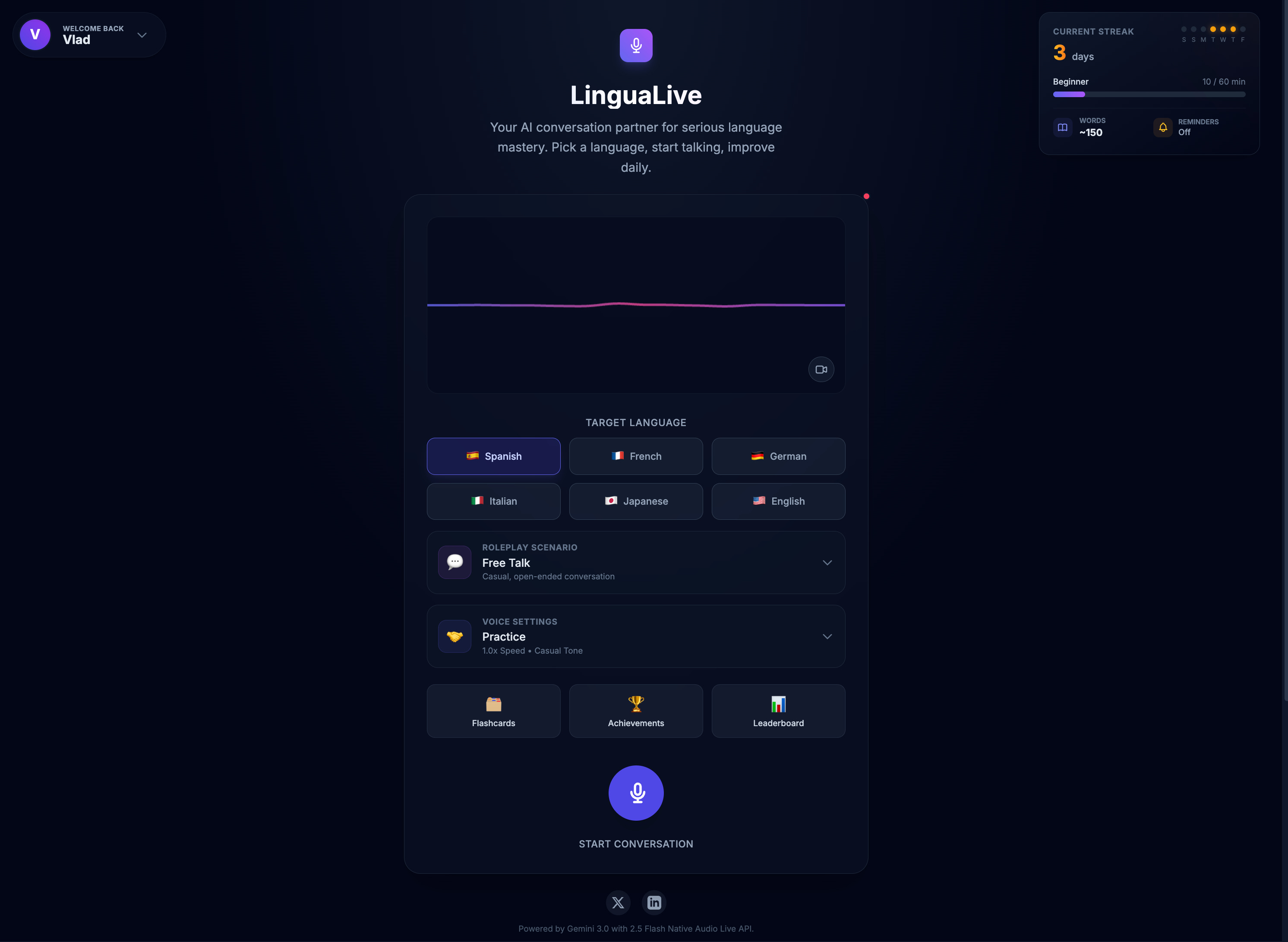
Tech stack:
Next.js for the frontend
Gemini Live API via WebSockets for real-time audio
Claude Opus 4.5 for polishing edge cases and conversation logic
Minimal UI: Pick a language. Hit record. Start talking.
Supabase: Database
Gemini builds fast. Claude thinks deeply. Together they’re unstoppable.
The implementation utilizes WebSockets, allowing your frontend to connect directly to the Live API and stream audio, thereby providing the lowest possible latency.
Total build time: One weekend.
The Complete Prompt Library
Here are the full prompts I use for each language.
Copy them. Modify them. Build your own products with them.