

Hey.
The most important technology in Dune is not spice.
It is the human being.
Frank Herbert’s universe is usually remembered for sandworms, desert warfare, prophecy, political intrigue, and Timothée Chalamet staring intensely into the distance. Underneath all of that sits a much stranger technological premise. After the Butlerian Jihad, humanity forbids machines capable of imitating the human mind, and civilization does not become primitive. It does not stop developing technology. It redirects its entire intelligence project inward.
Mentats become human computers, trained to process enormous amounts of information and run complex strategic calculations. Guild Navigators alter their bodies and perception until they can guide ships across space. The Bene Gesserit train attention, memory, language, observation, physiology and self-control until discipline begins to look like magic. Behind all of them sits a breeding program running across generations, designed to produce the Kwisatz Haderach.
Dune is not a low-tech future. It is a future in which the most advanced technology moved under the skin.
We are building the reverse.
Every quarter, the machine receives more memory, more context, more reasoning, more autonomy and more tools. The model learns to code, research, negotiate, design, persuade, diagnose and plan. The data center grows. The chip gets faster. The agent gets more independent.
The human gets another productivity app. Maybe a sleep tracker. Maybe a supplement. Maybe a new morning routine.
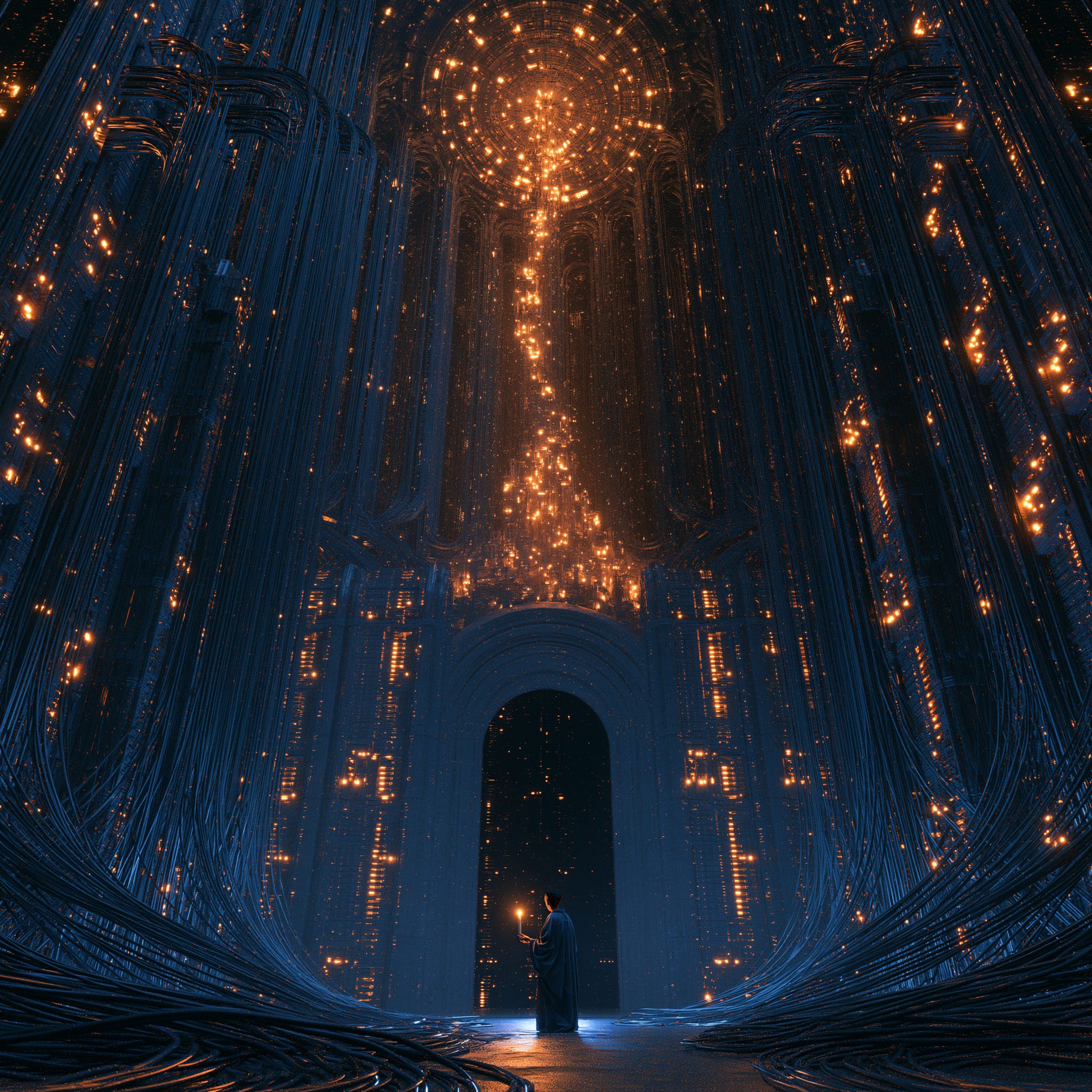
We are not failing to amplify intelligence. We are amplifying one kind of intelligence at historic speed while treating the other as fixed.
The last fixed variable
I am not writing this as a Luddite. In practical terms, I am deeply long AI. I use it across my companies every day, in sales, marketing, product, research, operations, writing and decision-making. I have seen what happens when a capable person suddenly has ten, twenty or fifty artificial collaborators.
The results can be extraordinary. Work that once required a department gets done by a small team. A founder can explore more ideas, test more assumptions and ship more products than would have been imaginable a few years ago. A person who cannot code now creates software. A person who cannot design generates a visual direction. A person who has never worked as an analyst interrogates a dataset.
That is real amplification. And precisely because I use these systems every day, I can see the imbalance more clearly.
Every model release raises the ceiling of machine capability. Human attention does not increase. Human working memory does not increase. Our ability to understand complex systems does not automatically increase, and neither does our patience, emotional regulation, resistance to manipulation, or willingness to change our minds.
The machine gets better at producing answers. The human remains responsible for deciding which answers are correct, useful, ethical, and worth acting on.
That gap is the real bottleneck.
In The Attention Floor I argued that when generation becomes abundant, attention becomes the scarce resource underneath the whole economy. AI can generate thousands of strategies, emails, designs, analyses and experiments, but someone still has to evaluate them. Someone still has to decide what matters. Someone still has to accept responsibility when the answer is wrong.
The machines can produce forty thousand things. A human can seriously examine a few.
This is why keeping a “human in the loop” is not enough on its own. A person can sit inside a process without meaningfully controlling it. They receive a dashboard, review a summary, and click Approve, with no realistic ability to reconstruct the reasoning that produced the recommendation. The human stays in the interface and quietly disappears from the intelligence chain.
A human in the loop is not in control when the human cannot understand the loop.
At that point, approval becomes ceremonial. The system makes the decision, and the person performs the ritual of authorizing it.
There are two ways to respond to this bottleneck. The first is to remove the human from more of the process. The second is to strengthen the human.
Almost all the capital, talent, prestige and urgency are flowing toward the first.
The essay that changes the question
This week I read a fascinating and uncomfortable LessWrong essay titled “FAQ: Isn’t AGI coming too soon for reprogenetics to help?”
The author, TsviBT, argues that one of the most neglected approaches to surviving advanced AI is Human Intelligence Amplification, or HIA. Not making the machine less powerful. Not merely delaying it. Not writing a better policy document. Making the human more capable.
He puts the neglect in a single line worth stealing: you can be the three-thousandth person working on AI safety, the three-hundredth working on AI regulation, or roughly the third person working on amplifying human intelligence.
HIA can mean many things: better education, healthier childhood development, cognitive pharmaceuticals, brain-computer interfaces, gene therapies, AI-assisted thinking, or methods nobody has invented yet. The essay focuses heavily on the most controversial version, reprogenetics, meaning the use of reproductive technology and genetic information to influence the health or cognitive potential of future generations.
The obvious objection is brutal and reasonable. If AGI arrives within the next decade or two, a highly capable child born today will still be a child when the decisive moment arrives. Even if the technology works, it may work far too late to matter.
The author largely concedes this. If transformative AGI arrives within roughly fifteen years, reprogenetics is unlikely to contribute much to preventing it.
That concession makes the essay more interesting, not less.
The argument is not that reprogenetics wins under every timeline. The argument is that humanity may be making a serious portfolio mistake by behaving as though only one timeline exists.
Maybe AGI arrives in five years. Maybe fifteen. Maybe forty. Maybe current systems already contain most of the ingredients for general intelligence. Maybe they remain extraordinarily capable machines built largely from accumulated human knowledge, still missing some crucial engine for flexible, original reasoning.
Nobody can honestly put a precise date on this, and the honest forecasters are the ones who say so out loud. Six days ago, Rob Wiblin published his annual audit of AGI timelines at 80,000 Hours. He went through seven pieces of 2026 evidence, the revenue curves, the METR graph, Anthropic reporting that Claude now writes most of the code at Anthropic, and shortened his own timelines by about a year. In the same piece, he laid out four reasons a slower takeoff running into the mid-2030s remains very much on the table.
That is what the frontier of forecasting actually looks like right now. The people closest to the data are moving faster and hedging harder at the same time.
We may have confused an alarming forecast with permission to stop building anything that takes a long time.
No sensible founder cancels every five-year research programme because one consultant assigned a high probability to the market changing in three. You would size the bet. You would preserve optionality. You would invest aggressively in the immediate threat while keeping resources in the paths that become decisive if your timing is wrong.
Civilization should be at least as sophisticated as a startup portfolio.
A pause is not a plan
Much of the AGI safety conversation focuses on slowing development, regulating frontier systems, monitoring compute, testing models, securing laboratories and negotiating international agreements. All of that may be necessary. But even if it works, it leaves a deeper question unanswered.
Suppose governments cooperate. Suppose frontier compute becomes auditable. Suppose the leading labs slow down. Suppose humanity buys another ten, twenty or thirty years.
What do we do with them?
We pause, and then what?
A pause is not a destination. It is rented time, and rented time only matters when you know what you are building with it.
We can use it to improve alignment research, model evaluations, international governance, institutional resilience, and the security of AI systems. But what if the problem is not only that we lack time?
What if we also lack the minds capable of finding the answer?
More time does not solve a problem when the person at the desk cannot solve it. A longer deadline is useful only when the extra time changes the quality of the research, the tools available to the researcher, or the researcher's capability.
Otherwise, we spend thirty years letting the same cognitive bottleneck think about the same unsolved problem.
This is the strategic value of Human Intelligence Amplification. It does not merely give the existing solver more time. It attempts to improve the solver.
The essay borrows a poker expression: play to your outs. An out is one of the few remaining cards that can still turn a losing hand into a winning one. When the situation is dangerous, it is tempting to focus exclusively on incremental improvements because they feel achievable. But making a bad outcome arrive more slowly is not the same as creating a path to survival.
Strong human intelligence amplification may fail. It may arrive too late. It may create new risks. It may prove scientifically impossible at the scale its supporters imagine. But it is one of the few strategies that changes the underlying capability of the people responsible for solving the problem.
Let us give that strategy a less clinical name.
Call it Plan Human.
Civilization’s one-sided portfolio
As an entrepreneur and investor, I know what concentration risk looks like. Humanity’s intelligence portfolio is extraordinarily concentrated.
We are long AI models. We are long chips. We are long data centers. We are long energy infrastructure. We are long autonomous agents, synthetic data, robotics, reasoning systems, AI scientists and automated research.
Even many AI safety strategies accept the same underlying structure: machine intelligence is the rapidly compounding variable, while human intelligence is the stable variable that must somehow remain capable of governing it.
Our civilizational strategy fits in three lines:
Machine capability: compounding.
Human capability: mostly flat.
Human control: assumed.
That is not diversification. It is one enormous position held through several different accounts.
Plan Human is not an alternative to AI. It is the missing hedge against the possibility that biologically ordinary humans become incapable of understanding, governing or meaningfully directing the systems around them.
The case for the hedge does not require certainty. You do not need to believe strong reprogenetics will work. You do not need to believe brain-computer interfaces will produce superhuman cognition. You do not need to predict exactly when AGI arrives.
You only need to accept three propositions:
The timing of AGI remains genuinely uncertain.
Human cognitive limitations may become a major constraint on our ability to govern advanced technology.
At least some forms of human capability are improvable through medicine, education, technology, biology or better institutions.
If all three are plausible, investing almost nothing in the human side of the intelligence equation is irrational.
Civilisation has diversified across models, laboratories and countries while staying concentrated in one underlying bet: the machine gets smarter first.
What is that “Plan” actually means
Plan Human is not a store where wealthy parents order a child with perfect memory, blue eyes, musical talent and guaranteed admission to Oxford. That is the tabloid version.
The real version is broader, slower and less cinematic. It starts with one question: how do we increase humanity’s capacity to understand complexity, make good decisions, resist manipulation, stay healthy and cooperate around increasingly powerful technologies?
Some answers are already familiar. Maternal health matters. Childhood nutrition matters. Education matters. Mental healthcare matters. Protection from environmental toxins matters. Treating neurological disease matters. Extending the healthy cognitive lifespan matters.
These may sound ordinary next to genetic engineering, but their cumulative effect could be enormous. Before attempting to manufacture exceptional minds, we should stop unnecessarily damaging the minds already being born.
Other approaches are more experimental. Cognitive pharmaceuticals could improve certain mental abilities. Brain-computer interfaces could extend memory or communication. Somatic gene therapies could treat conditions affecting cognition. AI tutors could adapt education to each student. AI assistants could help adults reason more clearly, challenge their biases, and learn faster.
Reproductive genetics sits at the far edge of the spectrum. It could eventually include selecting among embryos using genetic information, producing larger numbers of embryos for selection, or making direct heritable genetic changes.
These are not equivalent technologies. They have different scientific limitations, different moral implications, and radically different risk profiles. They should not be collapsed into the single phrase “designer babies.”
At present, there is no reliable genius dial. Intelligence is not controlled by one gene. It is shaped by many genetic variants interacting with health, development, family, education, culture, environment and chance. Genetic predictions are probabilistic, not deterministic. They estimate tendencies across populations. They cannot guarantee the future of an individual person.
Anyone promising parents a guaranteed genius is selling science fiction. That does not make the research irrelevant. It means the distinctions matter.
Possible is not proven. Researchable is not ready. Powerful is not automatically legitimate.
A technology can be too immature to sell and still too important to ignore.
The optimists jump too quickly from genetic association to predictable outcome. The critics sometimes make the opposite mistake, jumping from present limitations to permanent impossibility. Neither position is especially scientific.
The honest answer is that we do not know how much cognitive amplification will be possible, which methods will work, how long they will take, or whether their benefits can outweigh their risks. That uncertainty is an argument for careful research. It is not an argument for hype, and it is not an argument for blindness.
Why not simply upgrade adults?
The obvious alternative to reprogenetics is adult enhancement, and it sounds faster. No waiting for a child to be born, grow up, get educated, and enter a field where their abilities could matter. Instead, improve the cognition of the scientists, policymakers, engineers and founders already working on critical problems.
I find this direction deeply interesting. Brain-computer interfaces, cognitive pharmaceuticals, neural implants, somatic gene therapies and AI-assisted reasoning could all become important parts of Plan Human.

But the word “adult” does not automatically mean “soon.”
The adult brain is extraordinarily complex, and we do not yet know which interventions could produce large, general improvements without serious side effects. A treatment that improves one narrow capacity could damage another. A device that increases information flow could overwhelm attention. A drug that improves focus could reduce creativity, sleep, emotional stability or long-term health. Progress may require long sequences of expensive experiments followed by years of adaptation.
Reproductive approaches are slow because children need time to grow. Adult approaches may be slow because brains are difficult to modify safely.
There is no obvious shortcut.
Perhaps brain-computer interfaces arrive first. Perhaps AI-assisted education proves more important than biology. Perhaps gene therapy becomes transformative. Perhaps reproductive technology produces only small improvements. Perhaps none of these produces anything close to strong amplification.
The correct response is not to crown a winner before the research has been done. The correct response is to build a portfolio.
Dune is a warning, not a blueprint
At this point Dune may sound like an advertisement for Plan Human.
It is not. It is the warning label.
The Bene Gesserit spend generations manipulating bloodlines to create a person with extraordinary cognitive and perceptual abilities, and eventually they succeed. They simply do not produce him at the time, in the form, or under the control they expected.
Paul Atreides arrives one generation early. He possesses much of the capability they wanted, and he does not become their instrument. The Bene Gesserit believed that because they designed the process, they would own the result.
They were wrong.
They solved capability and failed alignment.
We normally describe alignment as an AI problem. How do you create an intelligence more capable than its creators while ensuring it continues to serve their intentions?
Dune presents the biological version of the same problem. How do you create a person with greater foresight, agency, strategic intelligence and influence while assuming that person will accept the purpose you assigned them?
You probably cannot.
A more capable mind does not inherit the values of the institution that funded it. A more intelligent child is also more capable of questioning the parents, government, company or ideology that tried to define their future. The better the enhancement works, the less reasonable it becomes to expect obedience.
You can influence a person’s starting conditions. You cannot own their destination.
This may be the central mistake in both AI development and human enhancement. We imagine intelligence as a product feature. Increase reasoning. Increase memory. Increase strategic ability. Then point the improved system at the objective we selected.
But a mind is not an API.
The goal of Plan Human should not be to manufacture one superior person who solves everything for the rest of us. That path leads toward cults, authoritarianism and the fantasy that civilization can outsource responsibility to a savior.
We do not need a Kwisatz Haderach. We need a population more capable of recognizing when someone is pretending to be one.
Four books are already arguing about this
Dune asks what happens when the creation escapes. The Bene Gesserit want a superior human they can position inside their political system. They get the superior human and lose the political system. Their mistake is not only scientific, but it is also managerial: they assume extraordinary capability will remain subordinate to governance. Paul demonstrates that a sufficiently capable actor can become the governance. This is the optimistic danger of enhancement. The technology works, and the person it produces refuses to play the role written for them.
Brave New World asks what happens when the creation does not escape. Huxley imagines reproductive technology not as a path toward individual flourishing but as infrastructure for social control. Biology becomes a supply chain. The World State does not want unpredictable geniuses; it wants stable castes and people conditioned to enjoy the position assigned to them. The technology works perfectly. That is the horror.
Huxley’s real question is not which traits can be influenced. It is who controls the system that defines desirable traits. Parents? Markets? Governments? Employers? Insurance companies? Algorithms trained on the outcomes of previous generations?
The moment a society begins ranking future people, the values of the ranking institution enter the process. The history of eugenics is not a rhetorical distraction here. It is a warning about what happens when biological power combines with institutional certainty.
Flowers for Algernon asks what the experiment feels like. Daniel Keyes turns the civilizational argument inward. Charlie Gordon is not a performance metric. He is a person whose intelligence changes faster than his identity, relationships, emotional life and social environment can adapt. The researchers can measure his cognitive performance. They cannot measure what the transformation costs him. An intervention can improve measurable performance while destabilizing identity, intimacy, belonging and every relationship the person has.
The Gene asks whether we understand what we are touching. Siddhartha Mukherjee presents heredity as simultaneously powerful, complex, medically promising and politically explosive. Genes matter. They are not destiny. The history of genetics is full of real scientific progress and also of people who mistook partial understanding for complete control, taking uncertain biological knowledge and converting it into confident social policy.
The same danger exists today. We are getting better at measuring genetic variation. That does not mean we understand how a person emerges from genes, development, family, culture, health, randomness, and experience. Our ability to intervene may grow faster than our ability to predict the consequences, and that gap between power and understanding is where most of the worst technological mistakes begin.
Four books. One asks whether the enhanced person escapes control. One asks what happens when they cannot. One asks who pays when it goes wrong. One asks whether we understand the machinery at all.
Intelligence is an accelerator, not a steering wheel
The word “intelligence” sets its own trap. We talk about it as though it were a single number. Increase the number and the world improves.
But greater cognitive capability does not automatically produce greater morality, empathy, patience, courage or wisdom. Give a selfish person more intelligence and you may get a better strategist for selfishness. Give an authoritarian institution more capable people, and you may get more sophisticated authoritarianism. Give a fragile civilization stronger cognitive tools, and you may simply help it reach the cliff faster.
Intelligence is an accelerator, not a steering wheel.
Paul Atreides perceives more than almost anyone around him, and it does not give him a clean path through history. Prescience is not wisdom. Foresight is not freedom. Capability is not character.
A serious human intelligence program would therefore need to think well beyond IQ. What about attention? Emotional regulation? Curiosity? Creativity? Empathy? Resistance to manipulation? Long-term reasoning? Epistemic humility? The ability to change your mind? The ability to cooperate with people who hold different values?
Some of these are difficult to measure. Some may not be genetically separable. Some may emerge primarily from education, institutions, relationships and experience. That makes them harder to optimize. It may also make them more important.
A civilization of brilliant maximizers with incompatible objectives could be far more dangerous than a civilization of ordinary people with strong institutions and a habit of cooperating.
The objective cannot be a generation of higher scores. The objective must be a civilization more capable of remaining human under pressure.
What we already have
There is another possibility hidden inside this argument. AI itself can be a form of Human Intelligence Amplification.
A model that expands your memory, challenges your assumptions, reveals blind spots, explains unfamiliar concepts, and improves the quality of your decisions makes you more capable. That is augmentation.
An agent that researches the options, frames the question, selects the objective, makes the decision, executes it, and then asks you to click Approve is doing something different. That is replacement with a ceremonial consent layer.
Researchers have started naming this. The distinction they draw is between cognitive offloading, where you stay in charge and the tool executes, and cognitive surrender, where the tool generates the judgment itself and all that remains is whether you accept it. Typing an address into a satnav is offloading. You chose the restaurant. Asking a model whether to take the job, and then taking it, is not offloading at all.
The interface looks almost identical. The long-term effect on human agency is not.
An assistant that helps you think better amplifies you. An agent that thinks instead of you gradually makes you unnecessary.
The important question is not whether a machine is involved. It is whether the human is more capable after using it.
Does the tool improve your judgment? Does it help you understand more? Does it show you where your reasoning is weak? Does it make you more independent over time? Or does it simply remove the need for you to understand what is happening?
Most AI products measure tasks eliminated, hours saved, and outputs generated. Very few measure whether the person using the product is becoming a better thinker.
That may be the metric we are missing.
And here is the part almost nobody says out loud. We have already run a planet-scale experiment in modifying human cognition, and we did not need a single gene to do it. Fifteen years of feeds, notifications, and infinite scroll restructured attention, memory, and reading habits for billions of people, at a speed no reproductive technology could ever match. The lesson is not that software is evil. The lesson is that the cheapest, fastest lever on human capability was never biological. It was the interface. We pulled it hard, and we pulled it in the wrong direction.
The first version of Plan Human may not be genetic at all. It may be a category of software designed to leave the user more capable than it found them.
A good teacher eventually becomes less necessary, because the student got stronger. A bad AI product does the opposite. It becomes more necessary every month, because the user’s underlying capability quietly deteriorates.
The rules must come before the tools
A serious Plan Human needs principles before products. Not after the industry exists. Not after the first scandal. Not after inequality has become biological infrastructure.
Before.

Health before status
The first priority should be reducing suffering and expanding the conditions under which people can develop well. Preventing serious disease, improving maternal and childhood health, treating neurological conditions and extending healthy cognitive life are fundamentally different from manufacturing positional advantages for wealthy families.
The most important human upgrade may not begin with gene editing at all. It may begin with nutrition, mental healthcare, clean air, a safe childhood and an education system that does not waste capable minds.
Before designing future geniuses, we should stop destroying existing potential.
Evidence before markets
Research can tolerate uncertainty. Products sold to parents cannot hide it.
And this is no longer hypothetical. Polygenic embryo screening is already a product. One startup sells a service at around six thousand dollars that ranks IVF embryos on projected IQ, height and roughly nine hundred health traits, with a fuller package running to about thirty thousand for both parents and up to twenty embryos. The American College of Medical Genetics and Genomics has warned that the field moved too quickly on far too little evidence. MIT Technology Review still named embryo scoring one of its breakthrough technologies of 2026.
The law has already split. Selecting embryos on predicted high IQ is prohibited in the United Kingdom. In the United States, it is legal and largely unregulated.
So the debate is not arriving. It is priced, sold and jurisdiction-shopped.
The commercial pressure here will be enormous, because parents are uniquely vulnerable to promises about their children’s future. A company is not merely selling a medical procedure. It is selling hope, fear, status, and the suspicion that refusing could disadvantage the child.
That makes the standard of evidence more important, not less. A probability must not be marketed as destiny. A genetic association must not be presented as a guarantee. The possibility that a technology may eventually work cannot become an excuse for selling it before anyone knows whether it does.
Pluralism before optimization
There is no single ideal human. A society that optimizes everyone toward one definition of intelligence will become homogeneous, fragile and probably authoritarian.
Civilization needs analytical minds and imaginative minds. It needs skeptics and builders. It needs people who preserve institutions and people who challenge them. It needs introverts, leaders, artists, scientists, carers, explorers, and people whose contribution cannot be predicted by a standardized score.
Biological and cognitive diversity are not inefficiencies. They are resilience.
Civilization needs a portfolio of minds too.
Access before aristocracy
Capital already compounds across generations. So does property. So do networks, education and reputation.
If meaningful cognitive or biological enhancement becomes available only to wealthy families, financial inequality could harden into something far more permanent. The children of the rich would not merely inherit more capital. They would inherit an engineered advantage in accumulating the next round of it.
That is how a consumer product becomes a hereditary class system.
A technology capable of expanding human potential could instead become the foundation of biological aristocracy. The difference will not be determined by the science. It will be determined by access, pricing, law and political power.
The future person before the chooser
The person most affected by reproductive enhancement cannot consent to it. That does not make every intervention wrong. No child chooses their genes, parents, country, language, education or early environment.
But it means the welfare and future autonomy of that person must matter more than the ambition of the chooser.
A child is not a startup project. They should not be designed to satisfy a parent’s status anxiety, a government’s labour requirements, or a company’s model of an economically valuable citizen.
The goal cannot be obedience. It must be agency.
Any enhancement that produces a more capable person while reducing their freedom to define their own life is not human progress. It is a more sophisticated form of control.
No Butlerian Jihad
Frank Herbert imagined a civilization that responded to thinking machines by destroying them. We do not need to do that.
I do not want to ban AI. My companies run on it. I want better models, better agents, better medicine, better science and more capable tools.
I also want a civilization capable of understanding what those tools are doing.
The lesson of Dune is not that machines are evil and biology is pure. The lesson is that a civilization must be deliberate about where intelligence lives, who controls it, and what happens when capability escapes the institutions that created it.
Right now our development is almost entirely one-sided. We improve the machine. We automate the task. We remove the human bottleneck. Then we celebrate the efficiency gain without asking what happens to human capacity after years of no longer performing the task.
First the machine remembers for us. Then it writes for us. Then it recommends for us. Then it decides for us.
Eventually humans retain formal authority while losing the ability to independently understand the systems exercising it. A board can technically approve a strategy without understanding how it was produced. A voter can technically choose between policies framed by systems nobody can audit. A founder can technically approve thousands of agent actions that no person had time to review.
Control survives in form. It disappears in substance.
When understanding leaves the human, control usually follows.
Perhaps AGI arrives before reproductive genetics could matter. Perhaps reprogenetics never produces strong amplification. Perhaps adult enhancement works first. Perhaps the most effective human upgrades come from education, medicine, institutions, or AI systems designed to improve our thinking.
I do not know. The mistake would be to confuse uncertainty about one technology with irrelevance of the entire objective.
Uncertainty is an argument for a portfolio. It is not an argument for leaving the human mind out of the portfolio entirely.
The machine gets a new architecture every quarter. The human gets a morning routine.
That is not a civilization strategy. It is simply the default, and defaults do not need anyone’s permission to win.
The most important intelligence project of the AI age may be the one we have barely begun to fund: the human being.
We do not need to beat machines at being machines. We need to remain capable of deciding what machines are for.
A note on the obvious objection, honestly stated. The strongest case against everything above is that under short timelines this is a distraction: every pound and every researcher spent on human amplification is one not spent on alignment, evaluations and governance, the only levers that operate on the actual clock. If AGI lands in 2029, a healthier cohort born in 2027 changes nothing, and “portfolio thinking” becomes a way of feeling diversified while being useless. I think that objection is correct about reprogenetics specifically under short timelines, and the essay’s author concedes as much. I think it is wrong about the category. The cheapest interventions in Plan Human, education, childhood health, and software built to leave users sharper, pay off inside five years, not fifty. The expensive ones are the hedge. Sizing the bet is not the same as refusing to place it.
One question for the comments
If humanity could safely amplify one capacity in the next generation, what would you choose?
Intelligence? Attention? Empathy? Health? Creativity? Self-control? The ability to cooperate?
Then comes the much harder question:
Who should be allowed to choose?
Stay curious, stay grounded.
🎬 Post-Credit Scene
📚 Book
Dune, Frank Herbert. Read it again, but ignore the sandworms for a moment. Look at the human infrastructure: Mentats, Bene Gesserit, Guild Navigators, selective breeding, mental conditioning, and the political consequences of creating an intelligence its creators cannot control. It may be the best science-fiction novel ever written about capability and alignment, and it was published in 1965.
🎙️ Podcast
What the hell happened with AGI timelines in 2026?, 80,000 Hours. Published six days ago. Rob Wiblin walks through seven pieces of evidence from this year, shortens his own timelines by roughly a year, then spends the last ten minutes explaining why a slow takeoff into the mid-2030s is still entirely live. This is the single best argument I have heard this year for holding two timelines at once instead of picking the fashionable one.
📝 Essay
FAQ: Isn’t AGI coming too soon for reprogenetics to help?, TsviBT. The source of this edition. I do not agree with every assumption in it, and the author openly presents an argument in one direction rather than a neutral scientific review. It still asks the question almost nobody in the industry is asking: why are we investing so heavily in making machines smarter while treating human intelligence as permanently fixed?
🧪 Product
Embryo scoring, MIT Technology Review’s 10 Breakthrough Technologies 2026. Not a thought experiment. A product category, with pricing, competitors and a regulatory arbitrage map. Read this if you want to understand exactly how far ahead of the ethics the market already is, and how thin the science underneath the sales page still is.
🎬 Show
Dune: Part Three, official trailer. Extreme hype, im really waiting and will fight for the tickets, no jokes. In cinemas 18 December, adapted from Dune Messiah, set seventeen years after Part Two.
Thanks for reading.
Vlad