

Hey.
Right now, in the next sixty seconds, LinkedIn will receive around eleven thousand job applications. Most of them are good. Polished, tailored, keyword-perfect, generated in seconds.
That is not the good news. That is the problem.
A recruiter working hard can give real attention to maybe 40 applications in a day.
The machines can produce forty thousand in a minute. Sit with those two numbers next to each other, because the gap between them is the most important number in the economy, and almost nobody is pricing it.
Compute is free. Capability is free. The one input that does not scale is a human paying attention.
We spent three years asking the wrong question. The question was always “what can AI do,” and the answer kept getting bigger; we kept getting impressed, and we kept missing the thing happening underneath.

The bottleneck always moves
When you automate one step of any system, the work does not disappear.
It moves.
The bottleneck shifts to the next step that is still done by a human.
Rohit Krishnan has been making this point quietly for a year, and it is the most useful sentence in AI right now: if you spend less time writing, the thinking still has to happen somewhere. Automate the writing and the bottleneck becomes the reading. Automate the producing and the bottleneck becomes the judging.
So watch where the bottleneck has been migrating:
It left manufacturing and went to knowledge work.
It left knowledge work and went to decision-making.
Now it is leaving decision-making too, because agents can decide as well, and it is arriving at the one station it can never leave.
A human, with a fixed number of hours, paying attention.
Andrej Karpathy called this the decade of agents, not the year, the decade, because the hard part was never the model. The hard part is the slow, human, un-scalable layer that has to sit on top: someone who reads the output, catches the error, takes responsibility, decides it is good enough to ship. That layer does not get an upgrade.
You have the same twenty-four hours your grandfather had. So does your whole team, added together.
I call it the Attention Floor.
Once every other input becomes abundant and effectively free, the one input that cannot scale becomes the binding constraint, and therefore the price of everything. The floor under the whole economy is an hour of human attention, and it is the one thing the factories of Silicon Valley cannot manufacture.
You can already see it
You can already see the floor everywhere, if you know to look for it.
The recruiter cannot read the applications, so most hiring managers now report more personal involvement in hiring, not less, in the age of the tool that was supposed to save them time.
The senior engineer cannot review the code fast enough, because the junior agents write it faster than any human can check it, so the review queue becomes the bottleneck the whole team waits on.
The inbox fills with well-written messages nobody has time to truly read.
The feed fills with competent content nobody has time to truly watch.

In every case, the same thing happened. Supply went vertical. Attention stayed flat. And value quietly walked from the side that became infinite to the side that stayed scarce.
This is the part most people overlook, because it is counter-intuitive and a little unglamorous. Everyone is pricing capability. The GPUs, the model, the agent swarm, the tokens per second. All of it is racing toward free. But when a thing becomes free, the value does not vanish.
It moves next door, to whatever is still scarce.
Sunlight is free, so we pay for shade.
The thing that is actually becoming scarce, and therefore valuable, is the least futuristic thing in the building: a trusted human, awake, paying real attention to the right thing.
In an economy of infinite supply, the last scarce asset is a human who is actually paying attention.
Six moves for Monday
That is the worldview. Here is the Monday-morning version. Six moves to defend your Attention Floor this week.
Audit where your hours actually go. For three days, log what you gave real attention to. Most people find half their scarce capital is spent attending to things a filter should have killed.
Build a triage layer. Put agents and systems in front of you to sort, draft, and discard. The goal is simple: nothing reaches your attention that did not earn it.
Price an hour of your attention. Decide, explicitly, what a deliberate hour of your focus is worth, and refuse to spend it below that price. Saying no is not rude now. It is portfolio management.
Protect the deep block. One uninterrupted, high-trust attention block a day, defended like a board meeting. That is where your judgment actually happens.
Measure decisions, not output. Ask at the end of the week how many good decisions you made, not how much you produced. Output is the commodity. Decisions are the scarce good.
Spend attention where it compounds. A scarce resource invested in the right place grows. Point your hours at the few things that get more valuable over time, and let the agents have the rest.
If you do one thing, do the audit. You cannot defend a floor you have never measured.
Robots reading robots
Back to those eleven thousand applications a minute. There is a recruiter somewhere staring at the pile, and the pile is winning, and the temptation is to ask the machines for help reading what the machines wrote. That way lies madness, and an infinite regress of robots talking to robots while the one human in the loop slowly stops paying attention to any of it.
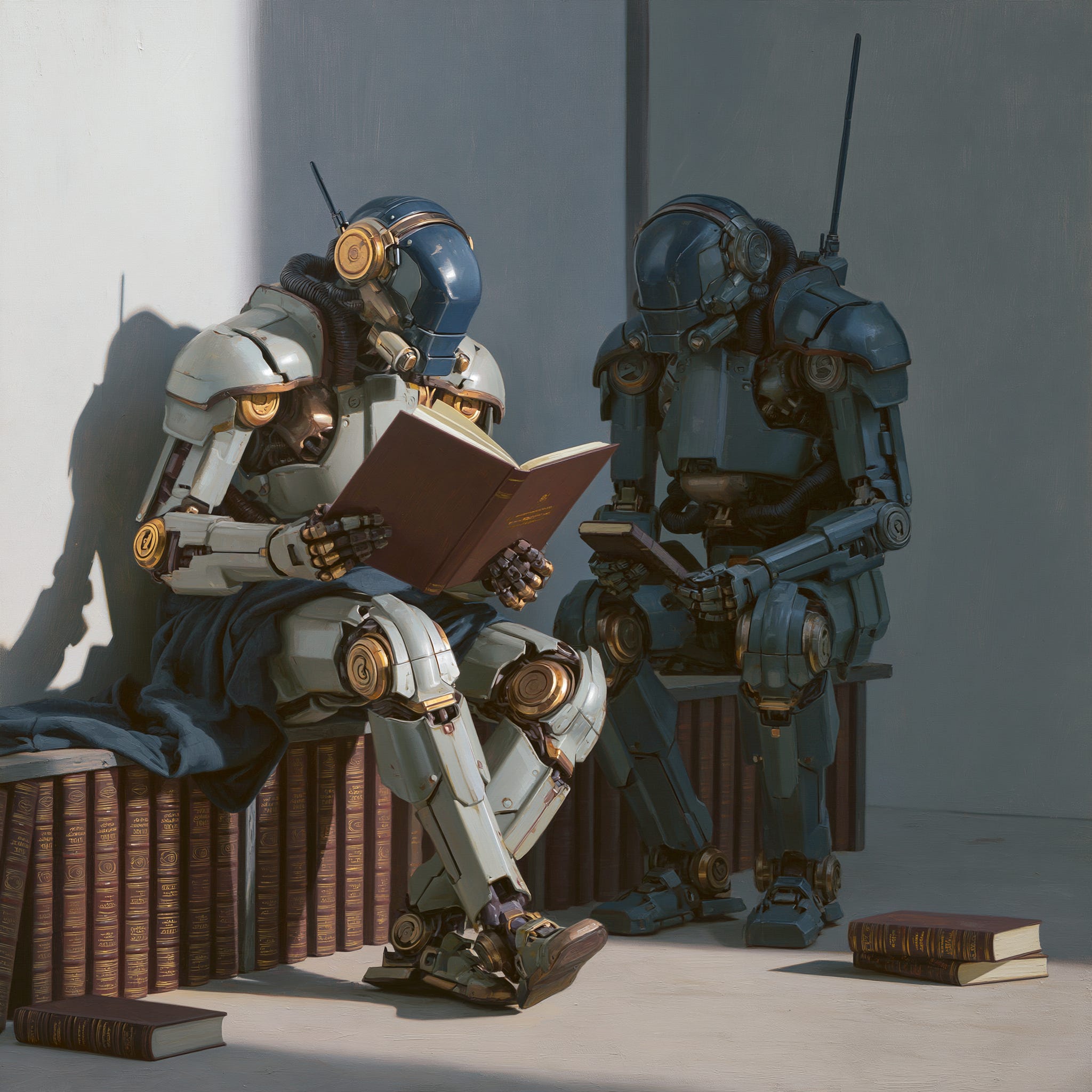
The future does not belong to whoever generates the most. It belongs to whoever spends the scarce human hour on the thing that actually matters, and has the judgment to know which thing that is.
Generation is free. Free things do not confer advantage.
I wrote once about the Instances Lottery, that the way to win with probabilistic tools is sheer volume of iteration. That is still true, and it is only half the truth. Iteration is free now. The attention to recognise the winning ticket among the thousand losing ones is not. That attention is the whole game.
Spend yours like it is the last scarce thing. Because it is.
Thanks for being here, and thanks for spending some of your fixed, unrepeatable, irreplaceable attention on this. I do not take the hour lightly.
Post-Credit Scene
Never is a strong word, and the obvious pushback is that models will eventually get trusted enough to do the judging too, collapsing the floor.
Maybe, at the edges. But trust is not a capability you can train into a model; it is a relationship someone is accountable for. As long as a human has to answer for the decision, a human has to attend to it.
“For now” has quietly covered every wave of automation so far, and “for now” is doing a lot of the work in that sentence.
📖 Book:
Momo by Michael Ende (1973). A children’s novel that is secretly the best book ever written about the attention economy. Grey “time-thief” men persuade a town to save time by living faster, and the town grows joyless and hollow as the saved time vanishes. Read it as a parable for every productivity tool you have ever installed.
Attention Span by Gloria Mark. The researcher who actually measured what happened to human focus in the digital age, with the data instead of the panic. The empirical floor under this whole edition.
Leisure: The Basis of Culture by Josef Pieper (1948). A German philosopher’s argument that the highest human things happen only in unhurried, undefended time. Deeply unfashionable. Exactly why you should read it in the decade of agents.
🎧 Podcast:
Dwarkesh Patel with Andrej Karpathy, “AGI is still a decade away”. The “decade of agents” conversation. Karpathy’s patience about how long the human-in-the-loop layer takes to build is the quiet centre of gravity for everything here.

✍️ Essay:
Your Attention Is Not a Resource by L. M. Sacasas (The Convivial Society). The necessary counter-melody. Sacasas argues attention is not a commodity you spend but the means by which you are present to the world. Read it right after you finish optimising your calendar, as penance.

Thanks for reading.
Vlad