

A year ago, more than a third of young people said AI made them feel excited. This year it is twenty-two percent.
The fall was fourteen points in a single year, and it was steepest among the people who use these tools every single day, the ones who should love them most.
That is not a dip. That is a collapse, and it happened fastest in the exact place the technology works best.
Making content.

You can feel it yourself when you scroll. The feed is smoother than it has ever been. More competent, more on-topic, more grammatically perfect, and somehow it leaves you with nothing.
“Your AI slop bores me” became one of the defining sentences of the year, and it was not a complaint about quality. The slop is not low quality. It is high quality and empty, which turns out to be worse.
We Printed Content
Start with the scale of the flood, because the numbers are genuinely difficult to hold in your head.
Ahrefs ran its detector across nearly a million fresh web pages and found AI fingerprints on roughly three out of four.
A separate study of more than sixty thousand articles found that over half of all new English-language writing is already mostly machine-made. Europol has warned that as much as ninety percent of what is online could be synthetic by the time you read this sentence.
We did the thing the technology was best at, instantly and at infinite scale. We printed content. And we are now learning the lesson every society that ever printed money has learned the hard way.
When you flood the supply of something, you do not make everyone rich in it. You make each unit of it worthless. A loaf of bread did not get more valuable in Weimar Germany because there was more money. It got more expensive because the money got worthless, and people stopped trusting paper and ran for anything real, anything scarce, anything that could not be printed. Gold. Land. A skill.
Content is in hyperinflation. Each individual piece is racing toward a value of zero, not because it is bad but because there is an infinite supply of things just as good. And the audience is already running for hard assets.
The Move Everyone Gets Wrong
Here is the move almost everyone gets wrong, because it feels productive and it is the opposite.
The reflexive response to cheap content is to make more of it. Faster. With better tools. Ten posts instead of three, a hundred instead of ten. That is standing in hyperinflation and printing more notes. You are adding to the exact glut that is destroying the value of your own work, and you are boring the one audience you have.
The contrarian response is deflationary.
Make less. Make it impossible to copy. And charge for the scarcity.
The Market Is Already Repricing You
The market is already pricing this, openly, right now. Fifty-two percent of consumers say they pull back the moment they suspect content is AI-generated. Adweek’s forecasters are watching human-made video command premiums of up to fifty percent. Digiday reports that creators’ authenticity, even their messiness, is suddenly in high demand. YouTube is reportedly exploring human-only feeds. A verification firm is rolling out biometric “human-made” stamps for content, the way a hallmark certifies real silver. A new word for an old instinct: when the copies are free, people will pay a premium for proof of the original.
This is Anti-Content Premium. The margin you earn precisely by refusing to scale.
And the principle underneath it, the one that will outlast every platform feature, is Scarcity Inversion: when the supply of a thing becomes infinite, value does not disappear. It migrates to whatever is next to it and remains scarce.
Words went infinite, so the value fled to the things words used to merely point at. Presence. A real human. A specific, accountable, unrepeatable point of view.
What Benjamin Knew
None of this is new. A German critic named Walter Benjamin saw the whole thing coming ninety years ago, and his essay is suddenly the most relevant document in the building.
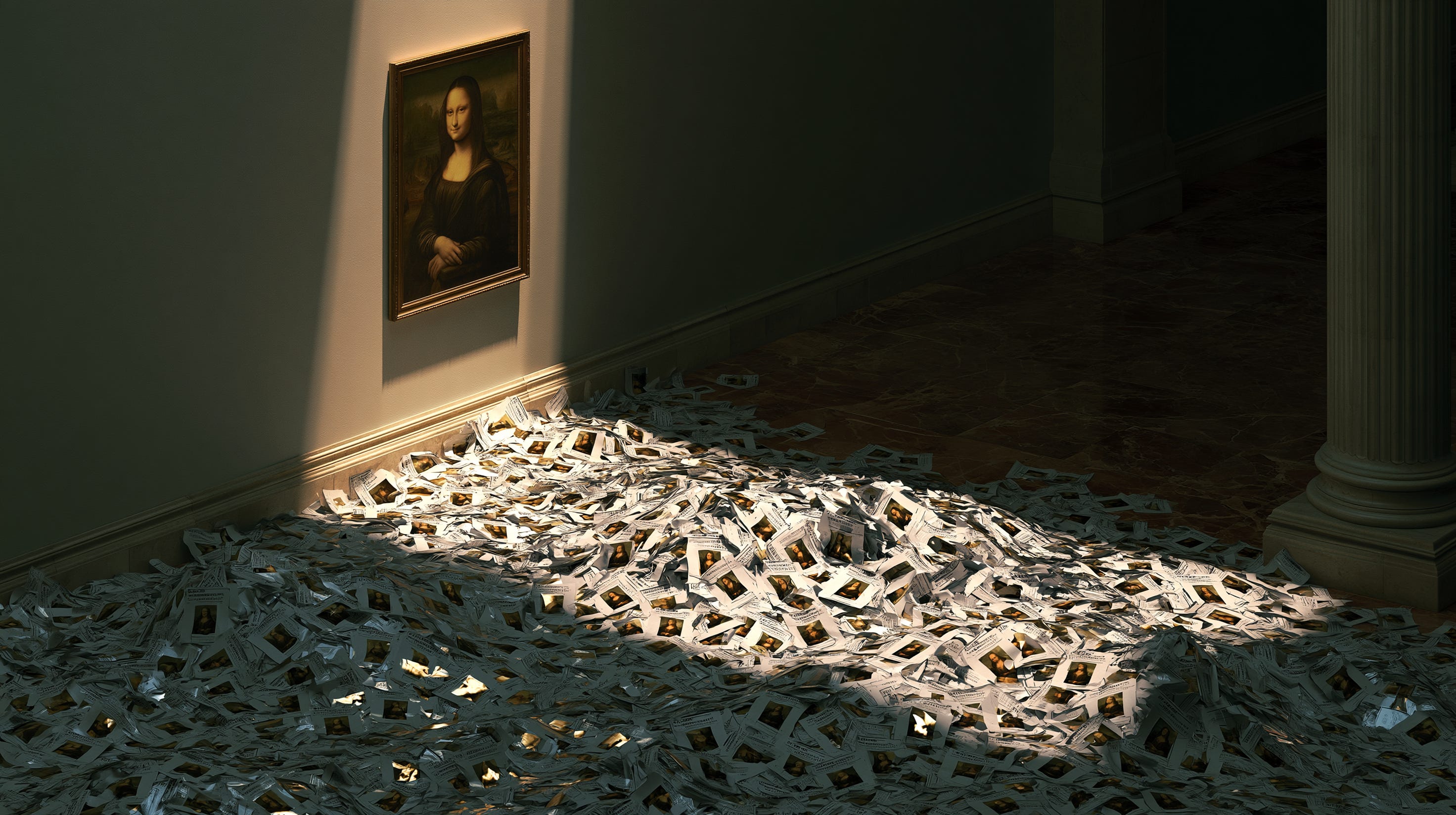
In 1936, watching photography and film make perfect copies possible for the first time, Benjamin argued that a work of art has an aura: a here-and-now, a presence rooted in the single physical original that no reproduction can carry. A print of the Mona Lisa is not the Mona Lisa.
The copy lacks the aura, the thread back to a specific hand in a specific place and time. He thought mechanical reproduction would dissolve the aura and democratise art, and he was half right.
But here is the part he half missed, and the part that matters for you. Infinite reproduction did not destroy the value of the auratic original. It concentrated it. The more posters of the Mona Lisa the world printed, the more singular and more priceless the one in the Louver became. Reproduction did not flatten the original. It made the original the only thing worth anything.
AI is mechanical reproduction aimed at meaning itself. It can now copy the surface of thought, the essay, the argument, the voice, infinitely and for free. And it is about to do to ideas exactly what the printing press did to images: make the perfect copies worthless and the auratic human original priceless.
The flood does not lower the value of the real thing. It is what creates the premium for it.
The Same Move, Whoever You Are
So stop printing, and start minting things with an aura. The move does not change based on what you do. It changes based on whether you are willing to make less and mean it.
Your volume is now your liability, not your moat. Every generic, competent, could-have-been-anyone piece you publish cheapens you, because it is indistinguishable from the infinite free supply. The answer is not more. It is the things only you have: the specific number (”my last cohort had twenty-three people, nineteen shipped a paid product”), the real name, the receipt, the opinion you would be embarrassed to be wrong about, your actual face and voice, the live and the unrepeatable. Make a quarter as much. Make it unmistakably, un-copyably yours.
“A human made this” has flipped from an apology into a premium. Stop hiding the human to look efficient. Show the hand. Stamp the work. People pay measurably more for the thing they can tell a person cared about, and they punish the thing they suspect a machine produced. That is not a values statement. It is a pricing opportunity, the same instinct I wrote about in The Marketing Contrarian: the people who win usually hate the circus of more, and reach for the one honest thing instead.
The same logic is about to rebuild the platforms. The next great ones will sell scarcity and proof-of-human the way the last ones sold reach and volume. Verified humanity, curated rooms, the credibly limited. Trust and aura are becoming product categories, not soft values.
Build the hallmark, not the printing press.
And your attention, the thing you spend without noticing, is the prize the slop is fighting for. It is being cheapened on purpose. Ration the free. Pay for the human. What you pay attention to is what survives.
Under all of it sits the one asset the model cannot reach: your specific, messy, accountable self. It can copy competence. It cannot copy that you were actually there, that your name is on a track record, that you will stand behind a real opinion.
This is the other half of the argument I made in AI Generalist: the value is not in any single skill the model can absorb, it is in the irreducible human who points all of it somewhere. Lean into the part of you that cannot be printed.
That is the worldview. If you want the part you can act on tomorrow morning, here it is. Six moves to build your Anti-Content Premium this week.
What to do this week?
Halve your output, double your care. Publish half as often, and put everything you saved into making each piece undeniably yours. Volume is the commodity. Restraint is the signal.
Put a verifiable specific in everything. A real number, a real name, a real outcome a skeptic could check. Specifics are the cheapest proof that a human was actually present.
Show the human. Your face, your voice, your process, the bit you got wrong. The “messiness” the market is suddenly paying for is just visible humanity.
Do one unrepeatable thing. A live session, a closed room, a piece tied to a specific moment that cannot be regenerated on demand. Aura lives in the here-and-now.
Stamp it. Make the human origin explicit and, where you can, provable. In a world heading for ninety percent synthetic, “really made by a person” is a hallmark worth wearing.
Charge for the scarcity. Do not give the auratic, unrepeatable, deeply human work away at the same price as the free flood. Price the premium, because the premium is real and measurable now.
If you do one thing, halve your output. You cannot build an aura while you are busy adding to the glut.
Go and Make One Real Thing
Back to that bored scroll, and the twenty-two percent. The feed is going to keep getting more competent and more hollow, because the incentives all point at more printing. Most people will read the slop fatigue as a problem to be solved with better AI content. They will print harder.
They have it backwards. The collapse is not a problem. It is the market repricing humanity in real time, and handing a premium to anyone willing to make less and mean it.
In a world drowning in competent copies, the rarest and most valuable thing you can make is something only you could have made. Everyone else is at the printing press.
Go and make one real thing.
Thanks for being here, and thanks for spending your scarce, un-printable attention on this instead of the infinite alternative. I will keep trying to make these worth the aura.
Post-Credit Scene
Five things worth your attention this week, all about value, scarcity, and the strange premium that appears the moment a thing can be copied for free.
📖 Book
When Money Dies, Adam Fergusson. The definitive account of the Weimar hyperinflation, and the clearest picture anywhere of what happens to a society when you flood the supply of something people trusted. Read it as a manual for the content economy, because it is one
🎧 Podcast
Tetragrammaton, Rick Rubin. A master class in the Anti-Content Premium: taste, restraint, and the discipline of making less but truer. Rubin built a career on knowing what to leave out. The exact opposite of “publish more, faster,” straight from the source.
📝 Essay
“The Work of Art in the Age of Mechanical Reproduction,” Walter Benjamin (1936). The ninety-year-old text that predicted this entire moment. His idea of aura is the most useful concept you can carry into a feed that is ninety percent synthetic. Short, strange, foundational.
🛠 Product
Content Credentials (C2PA). The provenance standard quietly becoming the hallmark for digital work: a tamper-evident “nutrition label” that records where a thing came from and whose hands touched it. Watch it next to the new biometric “human-made” badges rolling out this year. Proof-of-human is about to be a feature you can buy, not just a value you can claim.
🎬 Show
Jiro Dreams of Sushi. An old man in a tiny Tokyo basement, ten seats, one thing made with total devotion, decades deep. The purest portrait ever filmed of refusing to scale, and becoming irreplaceable because of it.
Thanks for reading.
Vlad