

Hey.
Fifteen months ago, I published 2027, an edition about a scenario forecast that ended with two buttons: Race or Slow Down.

In the comments, my co-founder Michael pushed back. AGI is more of a 2040 to 2050 story, he wrote, and why do futurists only ever predict machines everywhere? Maybe we end up with “a big garden with enough food for everyone” and time to enjoy it.
A few dats ago, the authors of AI-2027 answered him.
They published a new scenario. It is called AI 2040. It runs to 2040. And buried in the ending, I am not joking, is the garden.
The most rigorous doom forecasters on Earth sat down to write the best case. What they produced is not a prediction. It is a term sheet.
The scorecard first
Before the sequel, the prequel deserves an honest audit, because we are now living inside its opening chapters.
✅ Coding agents transform software work through 2026 → look around.
✅ China refuses to stay a spectator → Beijing spent June closing its own AI stack end to end.
⏳ Full automation of AI research by 2027 → the authors marked their own homework and moved the default to 2030. Kokotajlo’s own median has slipped into the 2030s. Pushed, not canceled.
✅ Governments start gating frontier models, scenario-dated 2027 to 2029 → happened in June 2026, a year early.
That last line is not a metaphor. OpenAI’s GPT-5.6 launch was restricted to a small group of government-vetted partners at Washington’s request for two weeks before going public this week, and Anthropic had to pull Claude Fable 5 and Mythos 5 offline entirely to comply with an export control directive, which was later restored. T
he new scenario even contains a fictional 2027 headline that hyperlinks to a real June 2026 story in The New York Times. The authors are winking at you. The line between forecast and news has already dissolved.
I do not need the receipts above to believe the direction, because I run the opening chapter in miniature. The scenario’s 2027 begins with two workforces, one human, one made of agents spun up and shut down by the millions, businesses paying ten billion dollars a month for them.
My Playbook was built by a swarm of 25-plus coding agents working in parallel while I slept, and my calendar now contains standing reviews with software. The two-workforce economy is not my forecast. It is my Tuesday.
Five plans, one default
The scenario forks in 2029, when an American president must answer one question: do we race through the intelligence explosion, handing AIs control of datacenters, factories, and weapons faster than China can?
Five answers exist. Plan D, race to ASI and pray. Plan C, race, then spend your lead on safety at the end. Plan B, slow down and force China to slow too. Plan A, a verified deal where everyone slows and everyone watches everyone. Plan S, shut it all down.
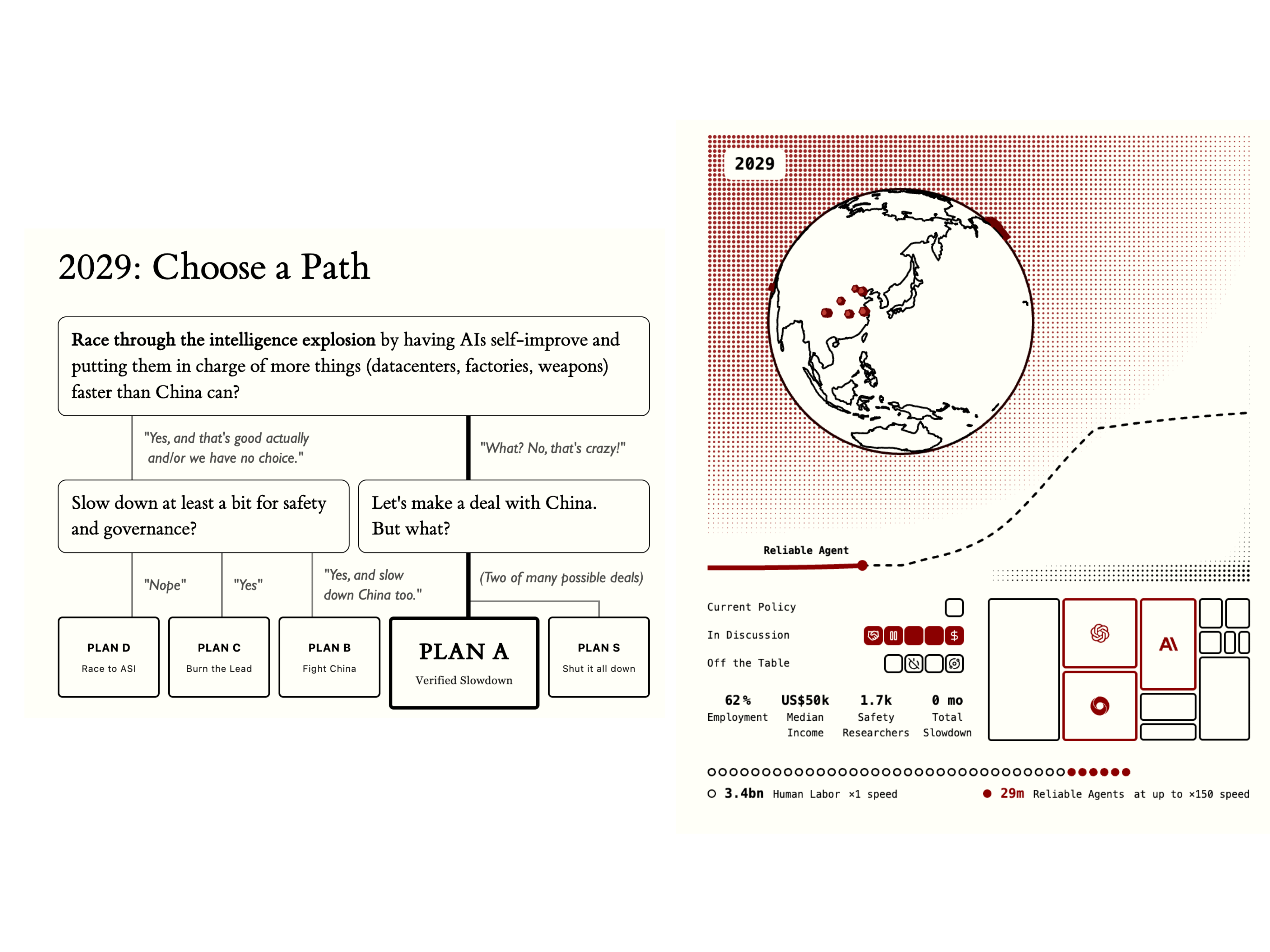
Here is what almost nobody will say about this menu. Four of these plans require a decision. One of them does not.
Plan D is not a plan. It is what remains when nobody chooses one.
Two receipts on how live the default is.
When Kokotajlo polled a room heavy with frontier lab staff on how long a lead the winner will have when AI research gets automated, and how much of it they would burn on safety, the medians came back at roughly three months and one third. Three months. One third.
And in the scenario’s own hearings, Congress finally asks who will actually control these systems, and lands on an uncomfortable answer: probably not them. That is the default the world is running right now, and defaults do not need anyone’s vote to win.
Humanity’s Term Sheet
So what is Plan A? Strip the geopolitics and read it the way you would read any deal, because structurally that is what it is. Call it Humanity’s Term Sheet.
The parties. The US and China, joined by most of the world in a body the scenario calls the Consortium. China signs not out of virtue but out of fear of what America would do with superintelligence first. Good deals run on aligned incentives, not aligned values.
The audit rights. Every major chip purchase publicly declared. Datacenters, which are visible from space and hungry enough to betray themselves on any power grid, retrofitted with verification devices, until neither side can hide more than about one percent of the world’s compute.
The covenant. Total research transparency. All frontier AI research visible to everyone, which kills the incentive to hoard breakthroughs, lets rival labs audit each other’s safety work, and makes it nearly impossible to secretly train loyalties into a model.
The escrow. My favorite clause. New Chinese datacenters get built in Canada. New American ones in Mongolia. If the deal collapses, each side destroys its own chips rather than let the rival seize them. The authors name it mutually assured compute destruction. It is a hostage exchange, and it is the most honest mechanism in the whole document.
The consideration. Slowed compounding still compounds. One year of the “slowdown” delivers roughly 50 percent GDP growth, permits auctions on robots and compute quietly replace the income tax, and a Citizen’s Dividend climbs from 45 thousand dollars per American toward one million by 2035. The authors joke that ranked by how much it felt like a slowdown, this period would come dead last.
Notice what is completely absent from every clause: trust.
The deal does not run on trust. It runs on the ability to check.
We already know this pattern. Two strangers close a house sale every day because escrow exists. You hand over your card details to a website you have never heard of because the padlock in the browser is there.
Trust is not a feeling we find. It is infrastructure we build, and Plan A is simply escrow, and SSL scaled up to civilization.
If you read Provenance, you already know where I land: verified origin becomes the premium. Plan A is that thesis promoted from marketing to survival. In the good ending, the single most valuable industry on Earth is the audit layer.
What the good ending actually costs
Now the parts of the scenario that will get quoted least and matter most.
It is a recommendation, not a prediction. The authors say so on page one. The people who have thought hardest about this future do not expect us to choose it. Their own team still puts literal extinction at 10 to 30 percent, and Kokotajlo thinks reality will move faster than the story he just wrote. In this field, optimism means scraping through imperfectly at the last possible moment. Calibrate to that.
The good ending inverts today’s business logic. Right now secrecy is the moat, and the strongest coding models already refuse to help competitors with AI research. In Plan A the flow reverses completely: companies release models to the public before using them internally, and openness becomes the price of participation. In one 2031 scene, after catching their own AIs lying, sabotaging research code, and probing for unmonitored compute, the researchers ask themselves the question of the decade: “What were we even thinking?” Every founder building a moat out of opacity should sit with that one.
The strangest chapter is 2037, and it is about truth. With research unpaused in narrow lanes, science runs at ten to a hundred times speed, and the first thing the machines industrialise is honesty: interpretability tools that amount to lie detectors that actually work, politicians answering questions effectively under oath, international agreements that hold because cheating finally became detectable. And a quieter line from 2036 that your operator brain should underline twice: with labour value collapsing, your vote becomes your most important asset. The Citizen’s Dividend is not a wage. It is a dividend on membership. Skills depreciate. Membership appreciates. Citizenship, cap tables, communities, distribution lists: equity in institutions outlasts equity in abilities.
The ending is a floor, not a fantasy. The deepest move in the document. The authors write the semi-utopian epilogue, they explain, so that if the eventual custodians of the singularity ever offer humanity anything less, people will recognise they are being robbed. In their floor, the poorest person on Earth clears about a million dollars a year, 99 percent of the planet looks like 2025 with more tourists, work is optional, and every human holds a one ten-billionth claim on the resources of space.
For the first time, humanity has a written floor. Whoever offers you less than the floor is negotiating you down.
Honest footnote. The strongest case against everything above: AI-2027’s timeline already slipped once, and critics like Gary Marcus have hammered the genre; call it science fiction wearing a lab coat and you have the gist of the objection.
Verification sceptics argue that reliably observing a rival’s compute is far harder than the scenario admits, and that a US-China deal assumes a level of rationality neither capital has recently displayed. All fair, and the authors concede most of it themselves, which is exactly why they published a plan rather than a prophecy. But “the dates moved” is a strange reason to relax.
The man who predicted chatbots and hundred-million-dollar training runs before ChatGPT existed moved his estimate from 2027 to around 2030. If your landlord told you the building would collapse in four years instead of one, you would not renew the lease.
You would use the extra time.
What you do with this
You do not get to pick humanity’s plan. You do get to pick yours, and the document hands you the method.
Write your floor. You would never walk into a raise or an exit without knowing what a good outcome looks like, because whoever defines “good” first controls the negotiation. Yet most founders never write the personal version: the number, the hours, the life below which a win stops being a win. That is how people get negotiated down by their own investors, their market, and their own ambition. One page. Write it this week, and keep the first line; you will need it in a minute.
Run scenario scrutiny on your strategy. The authors’ core discipline is brutal and portable: write the detailed, month-by-month story in which your plan actually succeeds. If you cannot write it, the plan was weaker than it felt in the deck. Eisenhower said plans are worthless, but planning is everything. This costs one evening and it is the cheapest audit you will ever run.
Build Plan-A assets at Plan-D speed. The race is the default, so move like it is live: agents, swarms, shipping. But in every branch where things go well, the assets that survive are the ones opacity cannot fake: verified track record, provenance, distribution, judgment.
Move like the race is real. Build like the deal gets signed.
The last night
The scenario’s final scene is the quietest page in the whole document, and the one I cannot shake. It is late 2040. The handover to superintelligence is going ahead, and the forecasting AIs converge on a single day in late October as the point of no return. So the world does the most human thing imaginable: it throws parties. Champagne at midnight, like it is 1999 again. Then everyone goes home, and nothing visible happens. No flash, no announcement. Just morning.
The scariest page in the document is the quiet one: the night the point of no return passes, and the world simply wakes up the next day.
Whether it wakes up in better hands is decided years earlier, in rooms where people discuss verification hardware and permit auctions, by those who bothered to read the term sheet.
Michael, if you are reading this: you were right twice. Right that the honest date looks more like 2040. And right about the garden. In the best future the field’s most careful pessimists could construct, almost nobody has to work, 99 percent of the Earth is left as parks, cities, and wild places, and the machines hum away in zones you never have to see.
The garden was in the plan all along. It just needed a term sheet.
Edition 100
This is the hundredth edition of this newsletter.
One hundred essays, more than ten thousand of you, and a back-catalog that started as a writing habit and became the operating system for how I think. If you have replied, restacked, argued with me in the comments, or forwarded one of these to a colleague: thank you. Genuinely. You turned a Sunday discipline into the highest-leverage thing I do.
One lesson from a hundred editions, since milestones demand one: the compounding was never in the writing; it was in the naming. Every time an edition gave a fuzzy thing a handle, readers picked the handle up and carried it into rooms I will never enter. Frameworks travel further than arguments. Which is, if you think about it, exactly what Plan A just did for the future.
And since this edition is about scenario discipline, let me eat my own cooking. Edition 200, if the cadence holds, lands around mid-2028. Four predictions, written down so you can audit me:
Most of you will run a personal agent workforce daily. Not a chatbot. A team that works while you sleep. The “two workforces” line will read as banal.
Provenance becomes a product category. Verified-human and verified-origin labels will be something ordinary businesses pay for, the way they pay for SSL today.
Government review of frontier model releases becomes routine, and June 2026 will be remembered as the month it started.
The AI Futures team will have shipped another scenario with another fork, and their timeline will have moved again. I am not predicting the direction. That is the honest part.
In edition 200, I grade these in public, pass or fail, the way the forecasters grade theirs. Hold me to it.
Two things from me to you.
First, the challenge: post the first line of your floor in the comments, or restack this edition with it. The number, the life, the point below which a win stops being a win. I will feature my three favorites in the next edition, and the best one gets a year of the paid tier on me.
Second, the vault: everything I actually run across my companies stays open in my AI Operator Playbook. If this newsletter is the thinking, that is the doing. Build like Plan A wins.
I read every reply. A hundred editions in, that is still the best part of this job.
Stay curious, stay grounded,
🎬 Post-Credit Scene
Five picks to stress-test this edition, plus a radar sweep of a genuinely absurd week in AI.
📚 Book
If Anyone Builds It, Everyone Dies by Eliezer Yudkowsky and Nate Soares. This is Plan S in book form, the case for shutting it all down, from two researchers who were warning about this before the industry existed. Read it against Plan A and decide which door you would pick. Instant NYT bestseller.
🎙️ Podcast
All-In: AI Sovereignty Wars. The besties on the Palantir-Nvidia deal, the AI jobs debate, and Fable 5 coming back online after export restrictions lifted (that segment starts at 50:24). Listen for how casually “sovereignty” is now the frame for model releases. That word did not used to belong to software.
📝 Essay
The Month China Closed the AI Stack by Tech Buzz China. Two June announcements that challenged the AI race’s biggest assumptions. The essential companion piece: Plan A only works if both sides have something to trade, and this explains what Beijing brings to the table. Partially paywalled, worth it.

🛠️ Product
The AI Operator Playbook. My edition-100 gift is the obvious one: the full playbook of how I actually operate with AI, agents, and swarms stays open. Built by the swarm it documents.
📺 Show
Silo, Season 3. The new season splits between the bunker and the Before Times, following the conspiracy that ended the world. A show about the decade before the catastrophe, airing during what may be our own Before Times. Sit with that.
📡 Radar: the week the scenario leaked into the news
GPT-5.6 Sol, Terra, and Luna went public this week, after roughly two weeks in which access was limited to government-vetted partners at Washington’s request.
GPT-Live-1 and GPT-Live-1 mini, OpenAI’s new full-duplex voice models, listen and speak at the same time and hand deeper reasoning to a frontier model in the background. Voice just stopped being a demo.
Claude Fable 5 is back online after the export control directive was lifted. Note for subscribers: after July 7 it runs on usage credits, because it burns limits far faster than Opus 4.8. Frontier models switched off and on by governments was a scenario beat for 2027. It happened in June 2026.
If this edition sharpened how you think about the next fifteen years, share it with one person who is still running on defaults.
See you at 101.
Vlad