

Hey. Something big is happening right now. To tell you about it, I need to get you into a bit of storytelling...and there are a lot of references and links to explain it properly.
In 1888, taking a photograph was a chemistry job.
You needed glass plates, chemicals, a darkroom, and the skill to use all three. Photography belonged to those who could run the process. Everyone else stood in front of the camera, not behind it.
Then George Eastman shipped a box.
It cost $25 and came loaded with film for 100 pictures. It didn't even have a proper viewfinder. You pointed it, pressed the button, and got on with your life. When the roll was finished, you mailed the whole camera back to the factory in Rochester, New York. For $10, Kodak developed the film, printed your pictures, loaded a fresh roll and sent everything back.
Eastman wrote the slogan himself, eight words long:
"You press the button, we do the rest."
He didn't build a better darkroom. He made the darkroom someone else's job.
Now look at your own screen. The CRM. The sequencer. The data tool. The enrichment tool. The warm-up dashboard. The deliverability checker. The calendar link. And the spreadsheet that reconciles the other seven.
That's a darkroom. We just moved it into the browser and started charging per seat.
This year the market finally noticed. In the first weeks of 2026, software stocks fell off a cliff, and traders called it the SaaSpocalypse. By October, the main software ETF was up 41% since mid-April. Both moves missed what is actually dying.
Software isn't dying. The interface is.
In 30 seconds:
The SaaSpocalypse is the 2026 software selloff that got its name on 3 February, when Thomson Reuters had its worst day on record after Anthropic released plugins for its Claude Cowork agent; by 12 October, the iShares software ETF (IGV) was up 41% since 13 April.
The Interface Tax is what you pay to operate software instead of receiving its result, in three lines: the Tab Tax (nearly 1,200 app switches a day in one Harvard Business Review study), the Setup Tax (weeks of work before the first result) and the Seat Tax (paying whether or not the result arrives). The 15-minute Interface Tax Return below prices yours.
Interfaceless software takes only your inputs and returns only results. By my count, one held B2B meeting booked by hand costs about 2,000 clicks; interfaceless, it costs about one, the click that joins the call. That's Dylan, the AI SDR we built at Belkins.
Lead gen is only where we start. Interfaceless Lead Generation comes first, then every other product we make, then every company we run.

SaaSpocalypse
The SaaSpocalypse is the name traders gave to the 2026 crash in software stocks, driven by the fear that AI agents would do the work companies used to buy software seats for.
It didn't start on one day. In January, the S&P North American software index fell 15%, its worst month since October 2008. But it got its name on a Tuesday. On 3 February, a few days after Anthropic released plugins that let its Claude Cowork agent handle legal, sales, marketing and data work, Thomson Reuters had its worst day on record. RELX fell 14%, its biggest drop since 1988. LegalZoom lost almost a fifth of its value in a single session. A Jefferies trader called it a SaaSpocalypse, the word stuck, and within about a week roughly $1 trillion of software market value was gone.
The logic was simple arithmetic. Most business software charges per person who logs in. If one agent does the work of five people, you buy one seat instead of five.
Then the market changed its mind. Between 13 April and 12 October, IGV, the iShares software ETF, rose 41%. The explanation was just as simple: the incumbents are selling AI into contracts they already hold, and their data, permissions, and audit trails sit in systems of record that every agent needs.
So which is it? Dead or alive?
Neither. Both crowds were looking at the wrong organ.
Listen to the people who build the stuff. At the end of 2024, on the BG2 podcast, Satya Nadella described business applications as databases with rules on top, and predicted that "all the logic will be in the AI tier".
This spring, Salesforce, the company that taught the world to sell seats, announced it would open its APIs and ship a headless product, and in May a16z's Seema Amble asked out loud whether software is losing its head. Then, on 8 October, Nadella published an essay on X called The Infinite SaaS Factory. It draws the future in two layers: Copilot as the one "head" people see, and a governed, headless layer underneath that exposes the business logic inside CRM, ERP and other applications to agents, with systems of record becoming more important, not less.
Here it is, straight from the source:

Strip out the corporate language and the picture is clear. The database survives. The rules survive. The data survives and gets more valuable. What goes is the part you operate: the screens, the tabs, the settings, and the seats that sit between what you want and what you get.
One more receipt, this time from the search bar. US searches for "saaspocalypse" went from almost nothing in January to nearly 10,000 in February, then fell about 98% by September, according to Ahrefs. The word died faster than the software did.
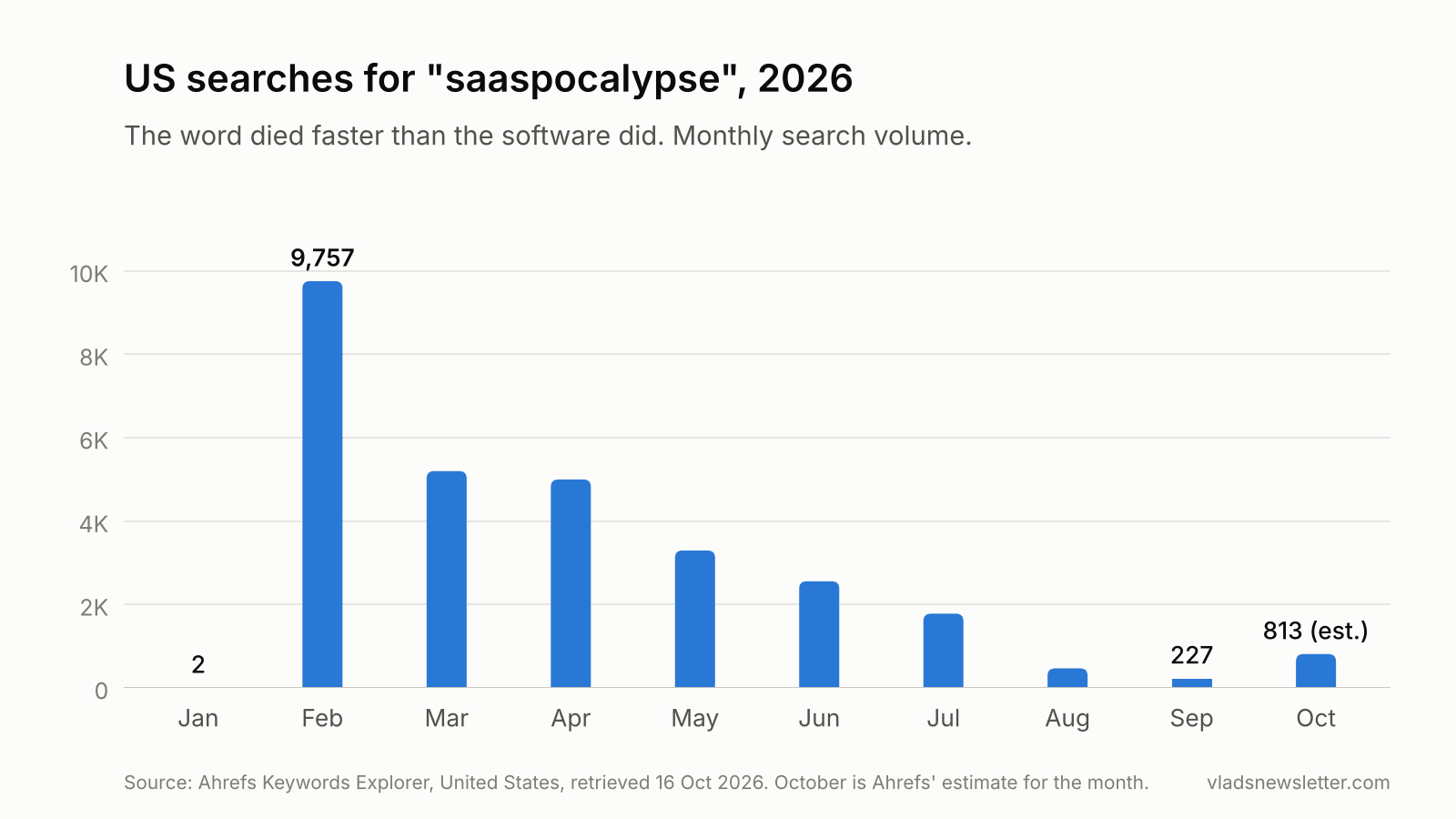
SaaS isn't dead. The cockpit is.
Interface
In September 1991, Mark Weiser, a computer scientist at Xerox PARC, opened an essay in Scientific American with a line I have reread more times than I can count: "The most profound technologies are those that disappear." He meant computers woven so deeply into everyday life that nobody notices them anymore.
Twenty-four years later, the designer Golden Krishna wrote a whole book on the same instinct, The Best Interface Is No Interface, including a chapter that mocks the industry's reflex to slap a screen on every problem.
They were right, and they were early. The interface survived for one reason. Between what you want and what you get, somebody has to do the work, and for decades software couldn't. So the software did the parts it could and handed the rest back to you, one button at a time.
That's the uncomfortable truth about every dashboard you have ever paid for. A dashboard is a receipt for work you did yourself.
In Tool-Shaped Worlds I wrote about Will Manidis's idea of tool-shaped objects: things that give you the feeling of work without the output. A hundred open tabs is the biggest tool-shaped object in business. It feels like a sales operation. Very often it's a costume of one.
Agents change the arithmetic. For the first time, the software can do the middle. Which makes the interface optional.
So here is the definition I'll use. Interfaceless software takes your inputs (your data, your intent and your rules) and gives you back the result, with nothing in between that you have to operate. Two screens: the brief and the receipt.
Every button is a job the software handed back to you.
Interface Tax
Every tool charges you twice. Once on the invoice, and once in everything you have to do to make it work. The second bill is bigger, and nobody itemises it. So let's itemise it.
The Interface Tax is what you pay to operate software instead of receiving its result. It comes in three lines: the Tab Tax, the Setup Tax and the Seat Tax.
The Tab Tax is attention. A study published in Harvard Business Review in 2022 followed 137 people at three Fortune 500 companies and found they switched between apps and websites nearly 1,200 times a day, losing nearly four hours a week finding their place again.
That's roughly five working weeks a year. Even before the agent wave, Salesforce's State of Sales survey of more than 7,700 sales professionals found that sales teams used about 10 tools to close deals, two-thirds of reps said they were drowning in them, and reps spent just 28% of their week actually selling. Zoom out and it gets worse.
The average organization runs more than 100 SaaS tools, according to BetterCloud, and this year's marketing technology landscape lists 15,505 products, more than 100 times as many as in 2011.
The Setup Tax is time.
It's everything you build before the first result is even possible, and outbound is the clearest example I know. Since 2024, Google and Yahoo have required bulk senders to authenticate their domains with SPF, DKIM, and DMARC, keep spam complaints under 0.3%, and honor one-click unsubscribes within two days. Then the new domains need warming. My favorite.
Published guides say anywhere from two weeks to three months, yet Smartlead's data on more than 850 million emails shows the average sender warms a new mailbox for just eight days before the first campaign. In my experience, dodging that line is the fastest way to burn a domain. Then come the list, the verification, the copy, the sequencer, the CRM, and the calendar. And you pay the whole thing again every time something breaks.
The Seat Tax is money for access.
Per seat, per contact, per credit, per mailbox, paid whether or not the result arrives. This is the line the SaaS-pocalypse was really pricing, and its replacement is already visible. Intercom's Fin AI agent charges $0.99 per outcome, such as a resolved conversation. In outbound, the equivalent is simple: you pay for meetings that actually happen.
Add the three lines together, and you get the real price of a tool. Not the sticker. The tax.
Ninety seconds, worth doing now: count the tools your team opens between "we want meetings" and "a meeting is in the calendar". Write the number on a sticky note. That's your Tab Tax, and it's the line almost everyone underestimates.
You were never buying software. You were renting a cockpit.
The Interface Tax Return
You can price your own Interface Tax in about 15 minutes. Do it for one workflow first: the one that ends in money.
Write the result in one line. "Held meetings with heads of operations at 200- to 1,000-person logistics companies." Not "more pipeline".
List every step between wanting it and getting it. Every tool, login, setting, approval, and wait. Include the spreadsheet that reconciles the other tools. Everyone has one.
Mark each step I, R, or T. Intent is what only you can supply: who you sell to, what you sell, who must never be contacted, and what counts as a result. Receipt is what you need to see to trust the outcome: the plan, the first message, the result itself. Tax is everything else, anything someone else could carry.
Price the three lines. Tab Tax: how many tools a human has to open. Setup Tax: days from "yes" to the first result. Seat Tax: the share of the workflow's spend you pay whether or not a result arrives.
Apply the rule.
The rule fits in one sentence. If the T steps outnumber the I and R steps combined, and the workflow isn't where your edge lives, stop operating it. Buy the result, or build the system that delivers it. Keep operating only where the operating is the edge.
Here's a worked example: launching cold outbound in 2026, the way most teams still do it.
Intent, 4 steps: define the buyer, write the offer in one line, list who must never be contacted, define what counts as a meeting.
Receipts, 3 steps: approve the plan, approve the first email, sit in the held meeting.
Tax, 13 steps: buy secondary domains, set SPF, DKIM and DMARC on each, create the mailboxes, connect a warm-up tool and wait, choose a data provider, enrich the list, verify the emails, write and test sequences, configure the sequencer, connect the CRM, set up booking links, watch inbox placement, triage the replies.
Now the bill, with typical numbers (illustrative; yours will differ):
Tab Tax: 10 to 12 tools, right around Salesforce's average of about 10.
Setup Tax: three to six weeks before the first email can even go out, most of it warm-up.
Seat Tax: close to 100%. Seats, data credits, mailboxes and warm-up are all paid before a single meeting exists.
In clicks: about 2,000 per held meeting, by my estimate. The working is in the next section.
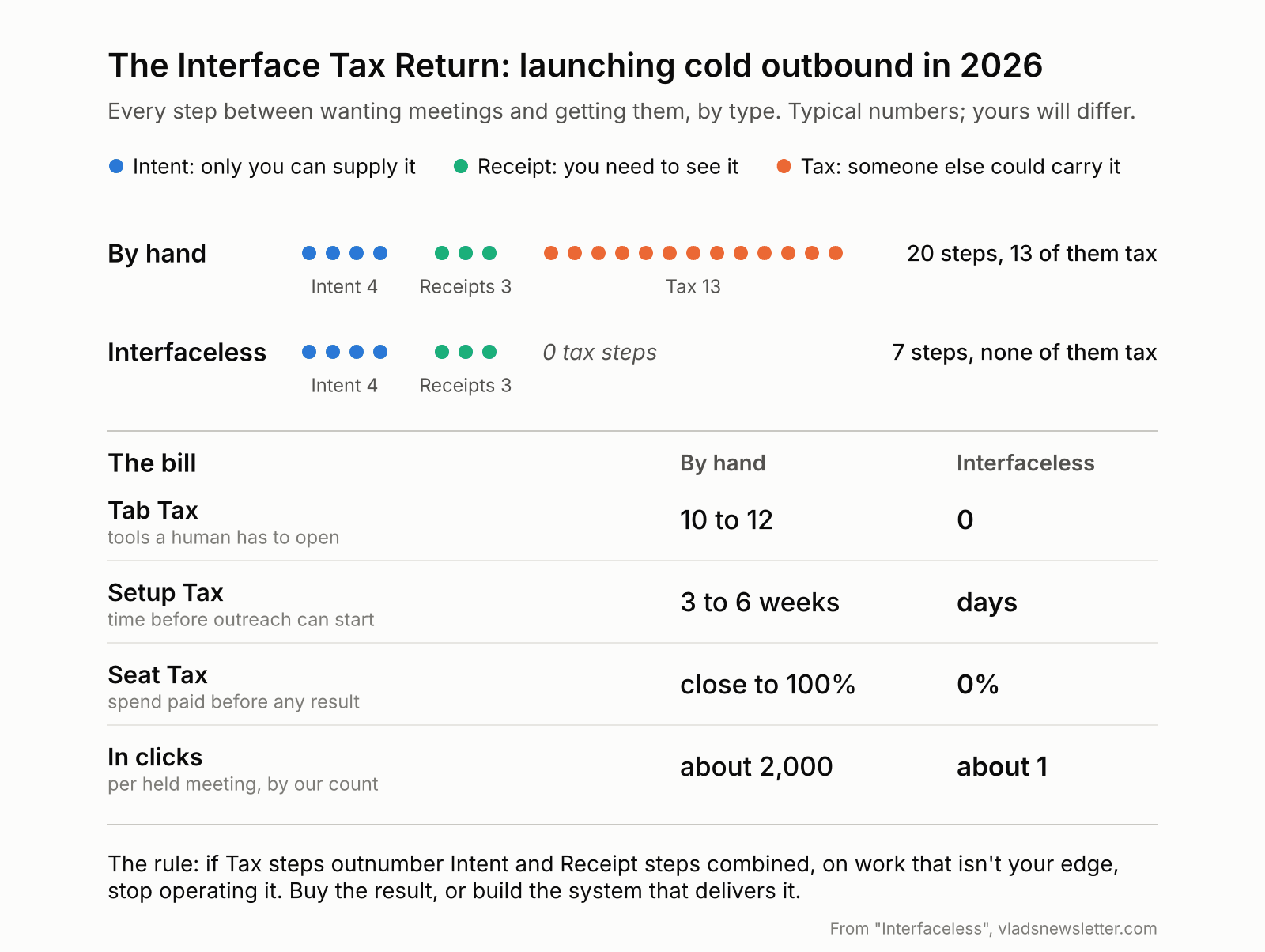
Thirteen Tax steps against seven Intent and Receipt steps. By the rule, unless running outbound infrastructure is your competitive edge, you shouldn't be operating this at all.
Now run the same workflow interfaceless. You keep the four Intent steps, which take minutes, and the three Receipts, which take a few clicks. The thirteen Tax steps become someone else's job. Tab Tax: zero tools, and about one click per meeting. Setup Tax: days, not weeks. Seat Tax: zero, because you only pay when a result arrives.
That paragraph was, almost word for word, the design brief for Dylan. More on him in a moment. First, your turn:
Keep the intent. Keep the receipts. Hand over the rest.
How many clicks does it take to book one meeting?
Ad platforms report cost per result. Nobody reports clicks per result. So I counted.
Clicks per Result is the number of times a person has to press something (a button, a link, a menu option or a form field) to get one unit of the outcome they actually want. It's the Interface Tax in its rawest unit. Keystrokes don't count, so writing an email is free in this ledger, which means the real number is higher.
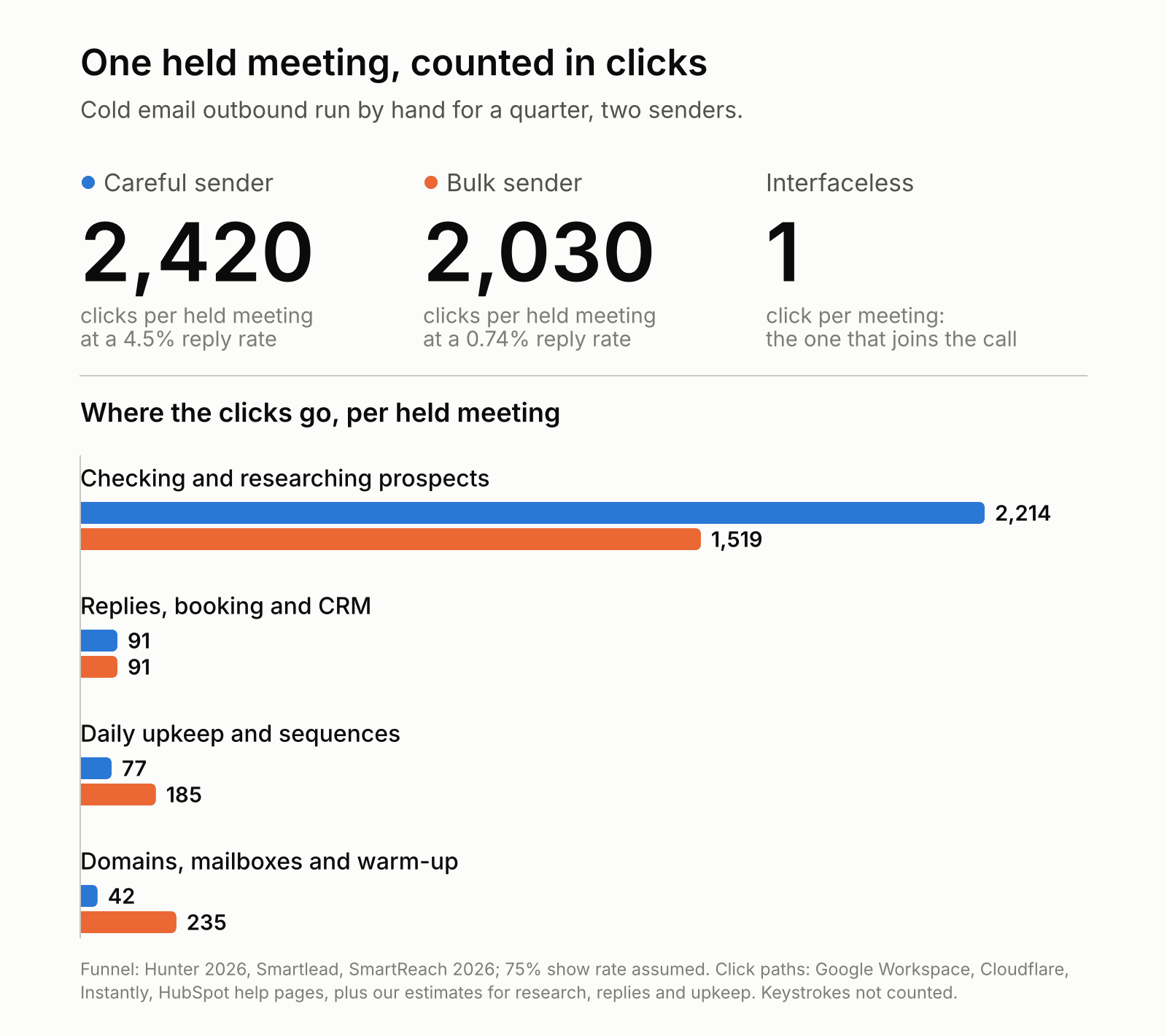
The result I counted is one held B2B meeting from cold email, run by hand by a small team over a quarter, on the usual stack: domains and DNS, Google Workspace, a sequencer with warm-up, a data tool and a CRM.
First, the funnel. Published reply rates disagree wildly, so I ran two senders:
The careful sender gets a reply from 4.5% of the people they write to, the average in Hunter's State of Email Outreach 2026, built on 31 million emails.
The bulk sender gets 0.74%, the median across more than 850 million emails in Belkins benchmarks.
Both see about 22% of replies turn positive and about 55% of those turn into a booked meeting, going by the agency cohort in SmartReach's State of Cold Email 2026. I assumed 75% of booked meetings actually happen, between the 64% one study reports for meetings booked from cold email (Focus Digital) and the 93.5% another reports across 6,428 meetings booked through a scheduling tool.
That's about 245 people written to for one held meeting if you're careful, and about 1,490 if you're not.
Then, the clicks. Wherever I could, I counted them one press at a time from the tools' own help pages:
Authenticating one sending domain, with DKIM switched on in Google Workspace and SPF, DKIM, DMARC and one MX record added at the DNS host: about 45 clicks, following Google and Cloudflare.
One mailbox, created, connected to the sequencer and warming up: about 30, following Google and Folderly.
One campaign of three or four emails, built and launched: about 46.
One booked meeting logged with a deal in the CRM: about 22, following HubSpot.
The human parts are my estimates: 9 clicks to check and research each prospect if you're careful (the profile, the company site, the news, a personal first line), 1 if you're bulk-loading, 3 to sort each reply, 11 to turn a positive reply into a booked meeting, and 10 to 25 a day of upkeep on mailboxes, warm-up and bounces. Most of the total comes from these, so treat it as an estimate, not a measurement.
Multiply it out and the answer is about 2,000 clicks per held meeting. The bulk sender pays 2,030. The careful one pays 2,420. And that's a floor: use the 64% show rate reported for cold email instead of my 75%, and both rise by about a sixth.
Two other roads point the same way. The Bridge Group's 2025 SDR report puts the median SDR quota at 10 held meetings a month and the median SDR at 112 activities a day: calls, emails, LinkedIn touches, and the rest.
That's about 235 activities per held meeting. At a conservative 4 clicks each, about what a connection request with a note takes by LinkedIn's own help page, it's about 940 clicks before a single list is built or a deal is logged.
Only 60% of SDRs hit that quota, the lowest in the report's history. And the 1,200 app switches a day from the HBR study, at 10 meetings a month, come to about 2,500 switches per held meeting.
Our own numbers suggest the count is, if anything, conservative. Belkins' 2025 data, published on our blog, covers 7.5 million emails from our 2025 client campaigns, 34,393 replies and over 1,200 booked appointments: at most about 6,300 emails per booked appointment.
Two things in the count surprised me.
Spray or snipe, you pay about the same. The careful sender clicks nine times per prospect and needs 245 of them. The bulk sender clicks once per prospect but needs 1,490, plus 51 mailboxes across 17 domains, to push about 44,700 emails over the quarter without landing in spam. The totals end up within 400 clicks of each other. You can't out-tactic the Interface Tax. You can only choose where you pay it.
Most of the clicks buy silence. For both senders, 73% to 87% of all the clicks go to people who never reply. Outbound by hand isn't clicking for meetings. It's clicking through silence to find one.
And the same meeting, interfaceless? About 20 clicks once, for the brief and the approvals. After that, roughly one click per meeting: one to join the call, plus one to approve each top-up.
From 2,000 clicks to one. The last button left says Join.
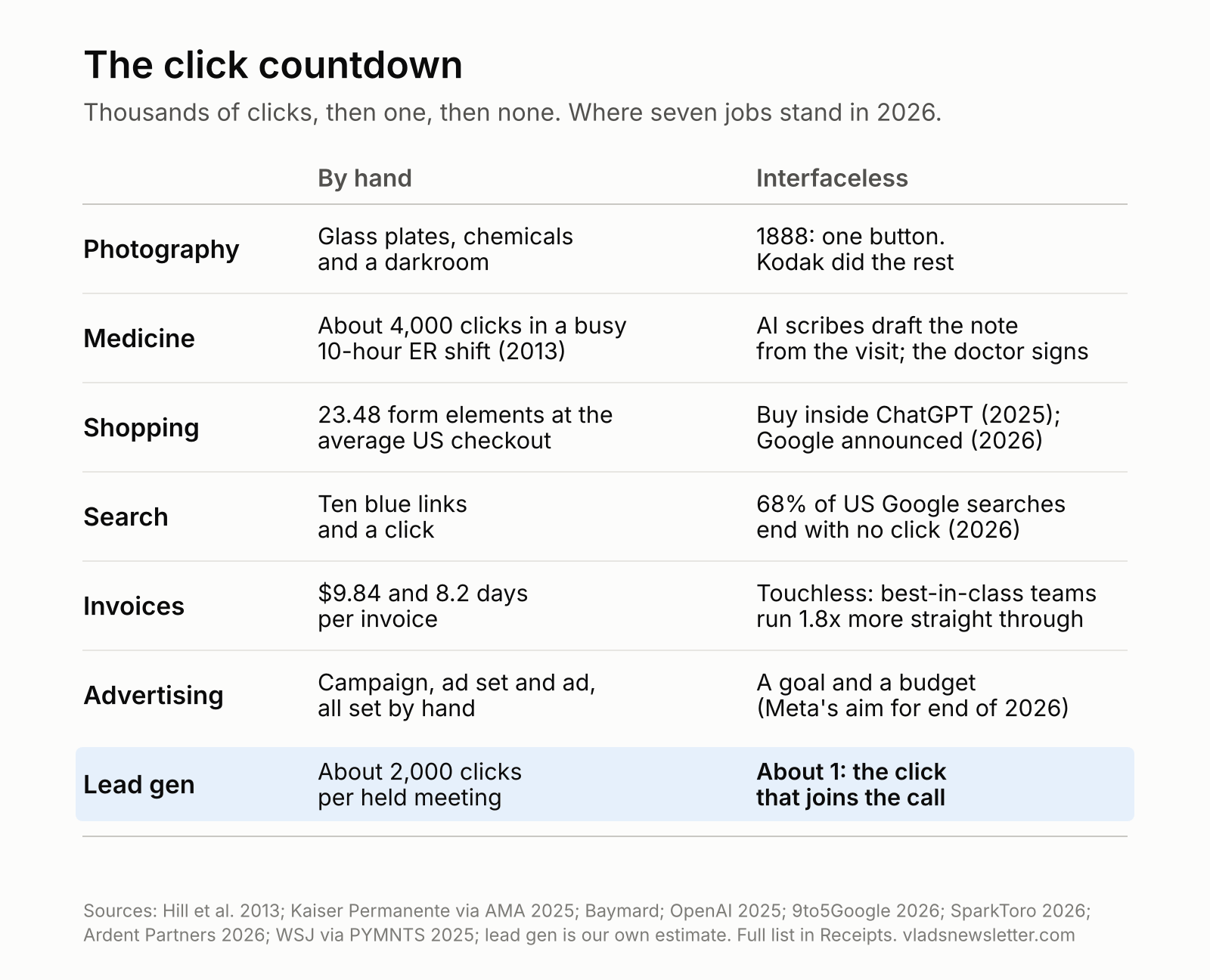
The click countdown
It’s more then you think. Lead gen isn't special. Every job done through a screen is on the same countdown: thousands of clicks, then one button, then none. Photography reached one button in 1888. Some industries are already close to none.
Medicine. In 2013, a study at one community hospital estimated that an emergency doctor's mouse clicks "approach 4000 during a busy 10-hour shift", with 43% of their time spent on data entry and 28% with patients (Hill, Sears and Melanson). Now the note writes itself from the conversation. Kaiser Permanente's ambient AI scribes covered about 2.6 million patient visits over 15 months and saved an estimated 15,791 hours of documentation (AMA). In a 2025 study of 263 clinicians, burnout fell from 51.9% to 38.8% after 30 days with one (JAMA Network Open). The doctor still reads and signs the note. That's the receipt.
Shopping. The average US checkout still shows 23.48 form elements, and 17% of US shoppers say they've abandoned an order because the checkout was too long or complicated (Baymard Institute). Amazon was granted its 1-Click patent in 1999 and licensed it to Apple a year later. In September 2025, OpenAI let people buy inside ChatGPT, and in January 2026 Google announced checkout inside AI Mode and Gemini.
Search. In 2024, 58.5% of US Google searches ended without a single click. A different panel put it at 68% in early 2026 (SparkToro). When Google shows an AI summary, people click a result on 8% of visits, versus 15% when it doesn't (Pew Research Center).
Invoices. Processing one supplier invoice costs $9.84 and takes 8.2 days on average. Best-in-class finance teams do it 79% cheaper and 79% faster, and push 1.8 times as many invoices straight through without anyone touching them. Accounts payable already has a name for zero clicks: touchless processing.
Advertising. A Meta campaign built by hand has three levels of settings: campaign, ad set and ad. In May 2025, Mark Zuckerberg described where that's heading: a business states its goal, then "you connect to your bank account, you don't need any creative". A month later, the Wall Street Journal reported that Meta aimed to let brands supply just a product image and a budget by the end of 2026.
Lead gen. About 2,000 clicks per held meeting by hand. About one, interfaceless.
The road isn't straight, and I'd be lying if I said it was. In March 2026, OpenAI scaled back its in-chat checkout. The Information counted only about a dozen Shopify merchants live, while Shopify put it closer to 30 (Forrester). Removing the button is the easy part. The stock, the payments and the returns still have to work behind it, which is the first thing most people overlook.
Thousands of clicks, then one, then none. Every screen is counting down.
What most people overlook about interfaceless
Everyone is arguing about whether the agents are smart enough. That isn't the interesting question. Here are five things I almost never see discussed, and we learned most of them the expensive way.
1. The darkroom doesn't disappear. It moves.
Eastman didn't abolish the darkroom. He moved it to Rochester and ran it at a scale no amateur could match. Interfaceless for the buyer means infrastructure-full for whoever delivers. In outbound, the domains, the warm-up, the sender reputation and the reply handling don't vanish. They move to whoever can carry them across thousands of mailboxes without burning them. The moat leaves the screen and goes into the plumbing, which is exactly what I argued in Good Plumbing: the boring systems engineering is the product. It's also why I think deliverability, the least glamorous layer in sales, is about to become the most important one.

2. Trust becomes the interface.
Automatic elevators were developed around 1900. People stepped in, saw no operator, and stepped straight back out. It took more than 50 years, and a 1945 strike in New York that kept about 1.5 million office workers from getting to work, before building owners pushed the change through. Even then the industry had to add trust by hand: a big red stop button, an emergency phone, a recorded voice explaining that the car was automatic, adverts showing children happily pressing the buttons.
The machine didn't need any of that. The humans did.
Interfaceless products need their own red button: approval before anything is sent, an undo, a do-not-contact list that is never crossed, an agent that says it's an agent, and a bill that only arrives with a result. Think of the flight map on the screen in front of your seat. You can't steer the plane, and you don't want to. But you always know where it is. That's the right amount of interface: observability, not controls.
3. The brief becomes the product.
A thermostat doesn't care whether you're right. Set it to 30 degrees, and it will heat your house perfectly to the wrong temperature. In the interface era, humans in the middle quietly fixed bad inputs, like the SDR who knew the target list was wrong and skipped half of it. When the middle disappears, nobody catches the mistake. Most companies have never written down who they sell to, who must never be contacted and what counts as a good meeting. That one page is now the most valuable document in the company, and most companies don't have it.
4. Agents bolted onto cockpits scale the mess.
In July, Gartner predicted that by 2028 AI agents will outnumber sellers ten to one, yet fewer than 40% of sellers will say agents made them more productive. Gartner's Dan Gottlieb explained why in one line:
"If those systems are fragmented, the agents will scale the fragmentation."
Add an agent to a twelve-tab stack and you get a twelve-tab stack with an agent in it. Copilots live inside the cockpit. Interfaceless removes the cockpit.
5. Your buyer is going interfaceless too.
In G2's March 2026 survey of 1,076 software buyers, 51% said they now start their research in an AI chatbot, 69% ended up choosing a different vendor than they had planned because of what a chatbot told them, and about a third bought from a company they had never heard of. Gmail's AI Inbox, in beta for Google's paying AI subscribers in the US, reads the Primary tab and turns it into to-dos and summaries. The first reader of your website and your email is increasingly a machine.
And when both sides of a deal are machines, the human layer becomes the premium: a real company behind the agent, a reputation worth protecting, honesty about who is talking. That's why Dylan tells every prospect he's an AI. It isn't a compliance checkbox. It's the brand.
Interfaceless doesn't mean less. It means everything moved to the side that can carry it.
Dylan and Interfaceless Lead Gen
Confession time.
In April, in Sell the Work, Not the Tool, I argued that the next winners in services would be autopilots that sell finished work, not copilots that sell tools. I described Belkins Home, the system we were building on eight years of our own delivery data, as our autopilot.
Sell the Work, Not the Tool

Hey. Few weeks ago, a Sequoia Capital partner named Julien Bek published a short essay that quietly rewired my thinking about everything I’m building.
Here's what I didn't understand yet. An autopilot still has a cockpit. Someone has to sit in it, read the gauges and know which switch turns it off. For months we built the most capable cockpit we had ever made. Then we watched who could actually fly it.
Us.
We had built buttons only we could press.
So we took the cockpit out.
What came out the other side has a name. Interfaceless Lead Generation is outbound where you supply only the inputs (your website, who you sell to, who must never be contacted and what counts as a meeting) and receive only the results: held meetings in your calendar.
We handle every step in between. We've started the patent process for it, because we think the method matters far more than any screen.
Dylan is the first product built this way. He's an AI SDR, which is software that does the job of a sales development rep: finding the right people, writing to them, following up, and booking the meeting. The difference is everything he doesn't ask of you.

You brief him in a few minutes: your website, who you want to meet, who he must never contact, and what counts as a meeting. A person at Belkins reviews his plan and sends it to you within one business day, and nothing goes out until you say yes. He writes from his own warmed domains and mailboxes, powered by Folderly, so your domain never sends a cold email. No DNS, no warm-up, no sequencer, no seat. Every first email says he's an AI and who he works for. He answers the routine replies, hands you anything about pricing, legal or complaints, and books the meetings into your calendar. And you pay for meetings that happen. Not for seats, not for emails, not for effort.
There's a 42-second film of the whole job on his site, from a website to a held meeting, if you want to see it rather than read it.

Run your Interface Tax Return on that, and you get four Intent steps, three Receipts, and zero Tax steps on your side. That's the whole point.
Here's the part I'm proudest of, and it isn't the agent. Belkins has run outbound for more than 1,000 companies across more than 50 industries since 2017, most of it by hand. Every one of those campaigns taught us which steps a client actually needs to see and which ones they were only ever paying for. Dylan is that knowledge with the cockpit removed.
Lead gen is only where we start. Interfaceless Lead Generation is the first thing we're building this way, and it won't be the last. Next, we do the same to every other product we make. Then we go after the rest of the stack: every tool a sales or marketing team still has to operate to get a result.
The rule doesn't change from product to product. You bring the data and the intent. You get the result. Nothing in between asks for your time: no setup on your side, no infrastructure to rent, no seat to pay for.
And it isn't only a product rule. We're pushing the interfaceless philosophy into every level of how we work, from how a client briefs us to how our own teams spend their week, and into every company we run. If a step is tax, we carry it, or a machine does. If it's intent or a receipt, it stays with the person it belongs to.
Interfaceless starts with lead gen. Then every product we make. Then every company we run.
I think this is the next era of sales and marketing. We're entering it early, and we intend to be the best at it.
Dylan is opening to a few teams at a time at meetdylan.ai. Or, if you live in a terminal, here's what his site calls the first lead gen CLI:
curl https://meetdylan.ai/join -d you@company.com
Two screens. The brief and the receipt.

Back to Rochester
Eastman's box didn't win because it was a better camera. It won because it sold the photograph, not the process. The darkroom didn't disappear. It moved to Rochester, where people who knew what they were doing ran it at scale. Twelve years later, in 1900, Kodak launched the $1 Brownie, and photography stopped being a hobby for the few.
Then comes the twist. In 1975 a young Kodak engineer named Steve Sasson built the first self-contained digital camera. The company that made the darkroom disappear now owned a darkroom of its own, an enormously profitable film business, and it protected it. In 2012, Kodak filed for bankruptcy.
That's the lesson I'm taking for us. The interface you remove today becomes the darkroom you defend tomorrow. The only way to stay on the right side of that story is to keep removing.
One hundred and thirty-eight years after Eastman's slogan, software is finally catching up with a box camera. Except this time the last button left is the one that joins the meeting.
You write the brief. We do the rest.
The best interface was never a better screen. It was the result, already done.
Post-Credit Scene
Welcome to the future. This is actually the AGI feel I got when we built Dylan, and what he is doing and how is just not good for my sleep haha.
Interfaces aren't only a tax. They are also where people learn, notice problems and stay in control, and aviation has spent decades studying "automation surprises", the moments when pilots can't tell what the autopilot is doing. The rebound in software stocks since April also says the companies with the screens aren't going anywhere soon.
I agree with both. That's why interfaceless, done properly, keeps the receipts and the red button: you approve before anything happens, you can take it back, and you see every result. And systems of record surviving isn't a rebuttal of the thesis. It is the thesis. The database lives. The cockpit goes.
You stayed past the credits. No buttons from here, just five picks.
📖 Book
In case you missed it: The Machine Stops by E. M. Forster (The Oxford and Cambridge Review, 1909). A short story about a humanity that lives entirely through a Machine that feeds, connects and entertains everyone, until it starts to fail and nobody remembers how it works. Read it as the dark mirror of this edition: interfaceless with no receipts, no red button and nobody left who understands the plumbing.
📝 Essay
Apps, Agents, and Aggregation by Ben Thompson (Stratechery, 28 September 2026). Thompson argues that agents operating computers expose apps as a means rather than an end, that one-size-fits-all interfaces give way to UI generated on demand, and that the real prize is owning the one agent each person works through. Read it next to Nadella's Infinite SaaS Factory and you'll see the same map drawn from two sides. Where I'd push further: in outbound, the buyer doesn't even need the agent's screen. Just the brief and the receipt.
🛠️ Product
Meet Dylan, experience yourself.
🎬 Show
Kodachrome, directed by Mark Raso (Netflix, 2018), with Ed Harris, Jason Sudeikis and Elizabeth Olsen. A dying photographer and his estranged son drive across America to reach the last lab in Parsons, Kansas, that can still develop his Kodachrome film before it stops for good.
🎬 In cinema
You Can See Everything is a genre-bending, three-hour documentary film about disgraced Theranos founder Elizabeth Holmes, co-directed by Nathan Fielder and Lance Oppenheim. It's something you don't want to miss.
Thanks for reading.
Vlad